







Secession, Tariffs, Sectionalism, Southern Rights, Slavery, Truth, Defeated Valor
One of my favorite quotes revealing the real causes of Southern secessions from the United States, beginning with South Carolina on December 20, 1860, and leading to six other secessions and Confederate artillery batteries in Charleston bombarding Union held Fort Sumter on April 12, 1861, is an early November editorial in the Charleston Mercury. On November 4, 1860, just two days before Lincoln’s election in November 6, the Charleston Mercury summed up the feeling of South Carolina on the impending national crisis:
“The real causes of dissatisfaction in the South with the North, are in the unjust taxation and expenditure of the taxes by the Government of the United States, and in the revolution the North has effected in this government, from a confederated republic to a national sectional despotism.”
The national unconstitutional sectional despotism referred to here was often condensed to “Sectionalism” in Southern speeches and essays.
Four other Southern States seceded after Lincoln’s April 15, 1861, call for 75,000 volunteers to forcibly put down the rebellion, although each seceding state followed strict legal and referendum procedures widely accepted as legitimate at the time.
As early as 1825. the right of secession was taught at West Point. William Rawle’s View of the Constitution specifically taught that secession was a right of each state and was used as a text at West Point in 1825 and 1826 and thereafter as a reference. Rawle was a friend of both George Washington and Benjamin Franklin, and his 1825 text was highly respected and used at many colleges. Rawle’s text explained:
“The secession of a state from the Union depends on the will of the people of each state. The people alone…hold the power to alter their constitution.”
The right of secession was very well stated by none other than by Congressman Abraham Lincoln himself in 1848:
“Any people anywhere, being inclined and having the power, have the right to rise up and shake off the existing government and form a new one that suits them better. This is a most valuable and most sacred right, a right which we hope and believe is to liberate the world.”
North Carolina was the eleventh state to secede on May 20, 1861. Regarding Lincoln’s call for 75,000 troops to put down Southern secessions on April 15, Governor John W. Ellis of North Carolina declared that:
“North Carolina would…”be no party to this wicked violation of the laws of the country and this war upon the liberties of a free people.”
Governor Claiborne Fox Jackson of Missouri was even harsher in his reply to Lincoln:
“Your requisition is illegal, unconstitutional, revolutionary, inhuman, diabolical, and cannot be complied with.”
Governor Beriah Magoffin of Kentucky wired Lincoln that:
“I say emphatically that Kentucky will furnish no troops for the wicked purpose of subduing her sister Southern states.”
Enraged by Lincoln’s call for American troops to invade Southern States, Virginia seceded on April 17. Shortly after Lincoln’s call to put down the “rebellion;” a prominent Northern politician wrote to Colonel John B. Baldwin, an eminent Virgina legislator and formerly strong Unionist, to enquire what Union men in Virginia would do now. Baldwin’s response was:
“There are now no Union men in Virginia. But those who were Union men will stand to their arms, and make a fight which shall go down in history as an illustration of what a brave people can do in defense of their liberties, after having exhausted every means of pacification.”
Maryland tried to secede on September 17 but had already been occupied by Union troops. The Lincoln administration blocked it by having pro-secession Maryland legislators arrested. Nevertheless, more than 20,000 Maryland men served in Confederate forces during the war.
Full Legislative secessions of Missouri and Kentucky were also blocked by occupation of Union troops. However, most of the Missouri Legislature was able to gather in Neosho, Missouri, to secede on October 31, 1861.
In Kentucky, representatives from 65 of 120 counties held a Convention in Russellville and voted for secession on June 16, 1862.
There are 13 stars in the Confederate Battle Flag, the last two represent Missouri and Kentucky. Lincoln was not on the ballot in most Southern States in 1860. However, he was on the ballot in Missouri and Kentucky. Lincoln received only 10 percent of the vote in Missouri and less the one percent of the vote in Kentucky, running fourth among four candidates. Lincoln received only 2.5 percent of the votes in Maryland in 1860.
From July 10 to October 28, 1861, four Oklahoma Indian tribes seceded from the United States and allied with the Southern Confederate States—the Choctaw, Creek, Seminole, and Cherokee. The distinguished themselves as cavalry, and among the most famous was Cherokee Brigadier General Stand Watie. An interesting account of the causes of the Civil War can be found in the Cherokee Declaration of Independence dated October 28, 1861.
“But in the Northern States the Cherokee people saw with alarm a violated constitution, all civil liberty put in peril, and all rules of civilized warfare and the dictates of common humanity and decency unhesitatingly disregarded. In the states which still adhered to the Union a military despotism had displaced civilian power and the laws became silent with arms. Free speech and almost free thought became a crime. The right of habeas corpus, guaranteed by the Constitution, disappeared at the nod of a Secretary of State or a general of the lowest grade. The mandate of the Chief Justice of the Supreme Court was at naught by the military power and this outrage on common right approved by a President sworn to support the constitution.”
“The humanities of war, which even barbarians respect, were no longer thought worthy to be observed. Foreign mercenaries…[were] enlisted and organized into brigades and sent into Southern States to aid in subjugating a people struggling for freedom, to burn, to plunder, and to commit the basest of outrages on the women; while the heels of armed tyranny trod upon the necks of Maryland and Missouri, and men of the highest character and position were incarcerated upon suspicion without process of law, in jails, forts, and prison ships, and even women were imprisoned by the arbitrary order of a President and Cabinet Ministers; while the press ceased to be free, and the publication of newspapers was suspended and their issues seized and destroyed;,,,”
Another little known fact is that southern Arizona and southern New Mexico seceded on March 16, 1861, and this was ratified by the Confederate Government on February 14, 1862.
Slavery was an issue but not primarily in its moral aspects. Northern States did not want to see further extension of slavery. The role and issues of slavery became increasingly distorted as the war progressed but especially after the war as a moral justification for the war. In recent times, this virtue-signaling distortion has become a socially destructive national false narrative close to academic and political tyranny.
How did the role of slavery become so distorted and exaggerated as a cause of the “Civil War”? In the words of President Woodrow Wilson, one of our most scholarly presidents:
“It was necessary to put the South at a moral disadvantage by transforming the contest from a war waged against states fighting for their independence into a war waged against states fighting for the maintenance and extension of slavery…”
It is politically and intellectually fashionable to distort the history of slavery in order to create a whitewashed version of American history that glorifies abolitionist radicalism and Northern aggression against the South while covering up the strongest underlying motivation for Northern opposition to the extension of slavery to new states. Northern whites did not want competition from black labor and wanted to keep the Northern states purely white. Lincoln, himself, stated this very clearly on October 16, 1854, in Peoria, Illinois:
“The whole nation is interested that the best use shall be made of these territories. We want them for the homes of free white people.”
This statement may be shocking to those who have been miseducated and brought up believing an overly polished understanding of Lincoln. Lincoln was a strong admirer of Henry Clay, who favored “colonization” to Africa and Central America as the only workable solution to slavery. According to Lerone Bennett, Jr. author of Forced into Glory in 2000, and former Editor of Ebony Magazine:
“On at least 14 occasions between 1854 and 1860, Lincoln said unambiguously that he believed the Negro race was inferior to the White race.”
There is some evidence, however, that Lincoln modified his beliefs influenced by appreciation of the 193,000 Blacks that had served in the Union Army and Navy, of which about half were from Southern States. Of the more than 2.2 million Union soldiers who served, 500,000 were foreign born, many recruited in Europe. This included 175,000 Germans and 150,000 Irish.
As to the cause of the Civil War, it should be noted that the Northern Congress passed a Resolution on July 22, 1861, stating specifically that preserving the Union and “maintaining the supremacy of the Constitution” and not interfering with slavery were the purposes of the war.
It should also be noted that Congress passed an Amendment to the Constitution on March 2, 1861, to be forwarded for approval by the states (3/4 required for approval) that would have permanently prohibited any interference with the institution of slavery in any state.
“No amendment shall be made to the Constitution which will authorize or give to Congress the power to abolish or interfere, within any State, with the domestic institutions thereof, including that of persons held to labor or service by the laws of such State.”
Lincoln endorsed this Constitutional Amendment in his March 4, 1861, Inauguration speech as well as the Morrill Tariff, which would increase average tariff rates from less than 16 percent to just over 26 percent by 1862, a 67 percent increase, and more than doubling them to 36 percent by 1865. Ninety-five percent of Federal income came from tariffs at that time. U.S. tariff revenues already fell disproportionately on the South, accounting for over 83 percent of the total, while Northern States received 75 to 80 percent for Northern public works and industrial subsidies, thus further enriching the North at the expense of the South. There had been a Tariff War between North and South at least since the first high tariff rates in 1824 and leading to a Constitutional Crisis by 1832. South Carolina Secession threats began in 1824. The Morrill Tariff was the real fuse for Secession beginning with Lincoln’s election in November 1860 and blazing into Civil War with Lincoln’s call for 75,000 troops to end Secession in April 1861.
It may be surprising to most people that only 26 percent of Southern families owned slaves. Only 25 to 30 percent of Confederate soldiers came from slave-owning families.
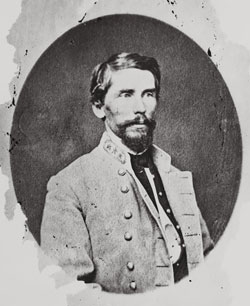
Shelby Foote, the author of the colorful 1.5 million-word, 3,000-page, three -volume The Civil War: a Narrative once said that Confederate Major General Patrick Cleburne was one of his favorite Southern officers.
Cleburne was born in Ireland on March 17, 1828 (St. Patrick’s Day) of Anglo-Irish parents and served in the 41st Regiment of Foot in the British Army form 1846 to 1849, rising to the rank of corporal. He emigrated to Helena, Arkansas in 1849, where he served as the town pharmacist, part owner of a newspaper, and a practicing lawyer until Arkansas seceded on May 6, 1861. He enlisted in the 1st Arkansas Rifles infantry regiment as a private but was soon elected as captain of his infantry company. The1st Arkansas Rifles became the 15th Arkansas Infantry and Cleburne its commanding officer before he was promoted to Brigadier General in March 1862. [One of my great-great-grandfathers, Alexander Ross (1828-12/1861), served under Cleburne.]
Cleburne never cared for slavery and favored emancipation and enlistment Blacks in the Confederate Army. His passion was for the Southern people who had welcomed him to Arkansas and made him one of their own. He believed strongly in States Rights. He was killed at the Battle of Franklin, near Nashville, Tennessee on November 30, 1864, at the age of 36, engaged to be married within weeks. Now that you know Patrick Cleburne, you will better understand this Patrick Cleburne quote shortly before his death:
"Surrender means that the history of this heroic struggle will be written by the enemy; that our youth will be trained by Northern school teachers; will learn from Northern school books their version of the War; will be impressed by all the influences of history and education to regard our gallant dead as traitors, and our maimed veterans as fit subjects for derision."
“It behooves the New South, in dismissing the animosities of the past, to see to it that they retain all that was true in its principles or ennobling in its example…Will you bury the history whose years are those of the God of Truth?”
—Rev. Robert L. Dabney, Confederate Chaplain and Stone Wall Jackson Chief of Staff, on June 15, 1882, Commencement at Hampden Sidney College in Virginia.
 Mike Scruggs is the author of two books: The Un-Civil War: Shattering the Historical Myths; and Lessons from the Vietnam War: Truths the Media Never Told You, and over 600 articles on military history, national security, intelligent design, genealogical genetics, immigration, current political affairs, Islam, and the Middle East.