






Results of September 18-20 Duma Elections
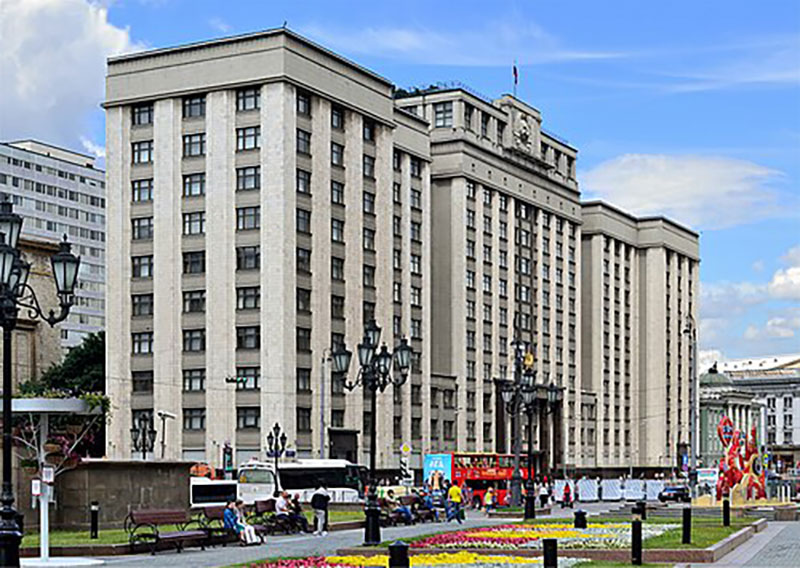
The Russian Duma, the Lower House of the Federal Assembly, is the equivalent of the U.S. House of Representatives. The word “Duma” comes from the Russian word for “thought” or “deliberation.” It consists of 450 Members (Deputies) elected every 5 years. The Russian Duma is elected by a combination of two methods. A Parliamentary style proportion of the popular national vote fills 225 seats, and a Constituency style vote for a single plurality winner in each of 225 districts fills 225 seats. The Parliamentary 225 are elected in the style of many European parliaments, and the Constituency vote closely resembles US Congressional district elections.
There is a Russian equivalent to the U.S. Senate called the Federal Council, but informally, the Senate. The Russian Senate is most similar to the US Senate before the US 17th Amendment in 1913. Two Senators are elected or appointed and approved by 89 regional district Legislatures, for a total of 178, whenever a district vacancy or a need arises. The regional districts consist of 24 republics, 48 states, 3 Federal cities, and 14 other independent governments equivalent to states. The complexities of the Senate will be covered briefly toward the end of this article.
Over 65.5 million registered voters participated in the 2026 Duma Elections. About 891,000 ballots, 1.4%, were rejected as blank or invalid, leaving 64.7 million valid votes. The turnout was 59.8% of registered voters, up 8.1% from the September 2021 election.
The total population of the Russian Federation for mid-2026 is estimated at 146 million excluding four predominantly Russian ethnic states—Donetsk, Lugansk, Kherson, and Zaporizhia—acquired in 2022 and voting for the first time in Russian Duma Elections for 2026. This would raise the total Russian Federation population by 8.6 million to 154.6 million. Four other predominantly Russian ethnic states—Odessa, Mykolaiv, Kharkiv, and Dnepropetrovsk—would add another 9.0 million population. Ukraine lost 2.3 million in population to Russia in 2014 with Russian acquisition of Crimea and Sevastopol, which were about 80% Russian ethnic and traditionally part of Russia until 1954, when it was arbitrarily transferred to Ukraine against the wishes of the people of Crimea and its political leaders.
In 2014, Ukraine had an ethnic Russian and mixed Russian-Ukrainian minority of 38% concentrated in the 9 predominantly Russian ethnic states mentioned here. In February 2014, the US, British, and George Soros backed a revolution and coup aimed at aligning Ukraine with NATO and the European Union. The new Ukrainian government implemented an anti-Russian ethnic cleansing and Ukrainization of predominantly Russian ethnic regions, causing a civil war. Much of the Ukraine War beginning in February 2022 resulted from Ukrainian mistreatment of Russian ethnics and trying to crush Russian culture. The Russian invasion of Ukraine at that time was NOT unprovoked. It had to do with both Russian national security objections to having a Ukrainian NATO state on its border and halting Ukrainian ethnic cleansing and atrocities against Russian ethnics in Ukraine.
Please also read about the Minsk II agreement in 2015 regarding the Ukrainian Civil War and its betrayal by Ukraine, Germany, France, the US, and UK.
There were 11 Russian political parties on the 2026 Duma ballot. There are more political parties, but to get on the ballot a party must have submitted a 200,000 names petition or have gotten 3% in the last election.
A party must receive at least 5% in the national Duma Election to receive any of the 225 seats allocated to parliamentary style election. Only 5 parties qualified with at least 5.0%. However, any party or independent can win election by getting a plurality in the 225 Constituency Elections. In fact, the Rodina party got one seat and independents took four seats.
Here are the results for the 5 parties qualifying for Parliamentary allocation of 225 seats:
United Russia 58.79% up 8.97%, 349 total Duma seats, up 25.
Communist 13.82% down 5.11%, 37 total Duma seats, down 20.
LPDR 9.05% up 1.50%, total Duma seats, 23, up 2
Note that the LPDR (Liberal Democratic Party of Russia) in not a “liberal” party in the American sense. It is probably the most conservative or the larger parties.
New People Party 7.98%, up 2.66%, 19 total Duma seats, up 6.
A Just Russia 5.34% down 2.12%, 17 total Duma seats, down 10.
Six Other parties not qualifying for Parliamentary allocation, totaled about 5.02%
They were:
Pensioners Party 1.97%
Greens 1.15%
Communists of Russia 0.84% (a Stalinist purist party)
Rodina 0.71% (But carried 1 Constituency District)
Direct Democracy 0.35%
Yabloko 0.00% (Disqualified in May 2026 by the Russian Supreme Court)
The Yabloko (Apple in Russian), officially the Russian United Democratic party, was disqualified by the Russian Supreme Court for Parliamentary votes, but not Constituency District votes. However, Yabloko won no Constituency votes. The Supreme Court Decision on Yabloko is being appealed. A frequent reason for party disqualification is foreign campaign money—outlawed in Russia. Recent US elections have been influenced by laundering multi-million foreign influence dollars. The US needs to outlaw and enforce laws against foreign financial influences in elections. Yabloko is socially liberal and progressive in the US sense and pro-European Union. It is the only Russian party that is specifically against Russia’s present war against Ukraine.
In the 225 Constituency Elections (CE) and the Results and Total All Seats (TAS) were:
CE TAS
United Russia 204 349 77.6%
Communist 5 37
A Just Russia 4 17
LDPR 2 23
Rodina 1 1
Independents 4 4
New People 0 19
Yabloko 0 0
All others 0 0
Total 225 450 100%
A Brief Description of the politics and ideology of the 11 parties on the 2026 Duma Ballot.
United Russia.
Center-right National Conservative, including social conservatism. Former Russian President Dmitry Medvedev is the leader of the United Russia Party. He is also the Deputy Chairman of the National Security Committee, which makes him the second most powerful political leader in Russia. He has become a hardliner on the Ukraine War. Next in importance in the Party and probably Russia is Foreign Minister Sergei Lavrov, also highly respected in the United Nations. Lavrov has become a hardliner.
CPRF Communists
Left to far left. Communism, Leninist Marxism.
LPDR
Don’t be confused by the “liberal” title. LPDR is right to far right. Strong Russian nationalism and Pan-Slavism.
New People
Center to Center Right. Close to libertarian, regionalism.
A Just Russia
Center Left socialism, but social conservatism.
Rodina
Far Right. Strong Russian nationalism. Strongly conservative populism.
Yabloko
Center Left. Social liberalism. Pro-European Union. Progressive, Anti-War. The only party to openly oppose Ukraine War. Under investigation for foreign financial support. Unable to win any seats in Duma.
Pensioners Party
Center to center right. Pension interests. Social conservatism.
Greens
Center. The Russian Ecological Party. Agrarianism. Ecological issues.
CR Communists
Far Left. Stalinist. Anti-revisionist Communists.
Direct Democracy
Center to center right. Direct democracy, E-democracy.
It should be noted that social conservatism is prevalent in Russia across several parties. This is undoubtedly the influence of the Russian Orthodox Church. Before the Communist Revolution in October 1917, Russia was one of the most Christian nations in the world. Christianity and the Russian Orthodox Church have made a considerable rebound since the fall of the Communist dominated Soviet Union. According to the Pew Research Center, adults who identify as Christian have risen from 31% in 1991 to 72%. Current estimates for the United States are about 64%. The vast majority of Russian Christians identify as Russian Orthodox. Moreover, Russian Orthodoxy is decidedly conservative on social issues, whereas many Western Christian denominations have been drifting to more liberal social positions.
Putin identifies as a Russian Orthodox Christian and has been influenced by at least four Russian Christian writers, including Solzhenitsyn. He has recommended several of these authors to his State Governors. Not the Putin you know from American media, politicians, the CIA, and Hillary Clinton? CIA propaganda has been demonizing Putin at least since 2007, when he began to criticize US foreign policy. This is standard CIA methodology for influencing foreign policy and American politics.
The Russian Federal Council or Senate
Russian Senators are elected or appointed depending on the needs or vacancies of each of 89 regional districts composed of Republics, States, City-States, and other forms of independent regional government. One Senator is elected by the respective legislature, and the other is appointed by the Governor or equivalent in each regional district. Since the President of Russia appoints most Governors since 2020 legislation, the President of the Russian Federation has a tremendous influence on the Senate. Internal Senate rules limit direct Presidential appointments to 30, but the Russian Federation President obviously has extraordinary influence over Senate membership.
Of the present 178 Senate seats, United Russia has a substantial majority of 136 seats (76%), the LPDR has 3, the CPRF Communists have 2, A Just Russia has one, and a whopping 34 are independent. There are presently two vacancies. The Russian Senate does not propose legislation, but Duma legislation must be passed by the Senate. The Chairman of the Senate is the third-ranking political officer in succession following the President and Prime Minister. The Present Chairwoman of the Senate is Valentina Matviyenko. By the way, the Prime Minister of Russia is Mikhail Mishustin, who has served since 2020.
There are some reasons why the Russian Senate is effectively so tightly controlled by the Moscow Kremlin government. The Russian Federation is by far the largest country in the world, spanning over 11 time zones. While predominantly Russian ethnic (about 81%) , the Russian Federation contains numerous predominantly or significantly ethnic populations, many of them predominantly Muslim. Invaders and ruthless competitors of Russia have often tried to use ethnic differences to weaken Russia and stir up separatist movements. Of recent memory are the Chechen wars of 1994 to 2009 and the brief Russo-Georgia War in 2008. Moreover, Russia has been invaded by powerful enemies in the past—Napoleon’s armies in 1812 and a massive invasion of more than 3.0 million German Nazi troops beginning in June 1941. Over 27 million Russians died in the struggle against Nazi Germany.. Hence Russians are extremely wary of any attempt to divide and conquer them. They are extremely alert to CIA and British MI6 intelligence activities and financing in Russia and bordering countries. The US Civil War and Reconstruction years resembled present Russian cautions regarding de-centralized government.
“The simple step of a courageous individual is not to take part in the lie. One word of truth outweighs the world.”—Aleksandr Solzhenitsyn
 Mike Scruggs is the author of two books: The Un-Civil War: Shattering the Historical Myths; and Lessons from the Vietnam War: Truths the Media Never Told You, and over 600 articles on military history, national security, intelligent design, genealogical genetics, immigration, current political affairs, Islam, and the Middle East.