












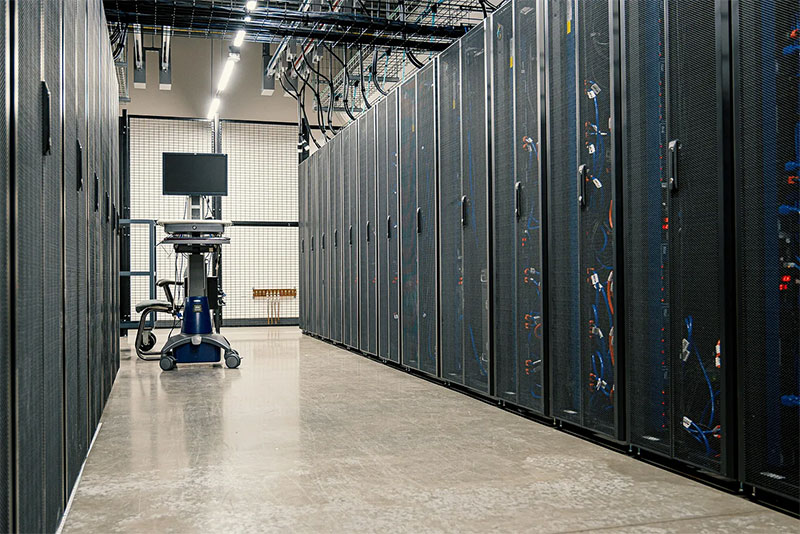
Google announced that it plans to invest $9 billion into South Carolina to expand its Berkeley County data center and build two new sites in Dorchester County. However, with the recent laws passed by the SC legislature and new information that has been released about data centers in the Palmetto State, it looks like its citizens will once again be subsidizing another globalist corporation.
The Devil in the Details
Google has revealed that it is behind what has been known as “Project Dawson” data center proposals after at least 18 months of secrecy. The company plans to invest $510 million into a 231-acre site in Dorchester County’s Pine Hill Business Campus. Google accomplished this deal behind the company names of Autumn Timber LLC and Mallard LLC, the former based out of Delaware. Dorchester County Council voted unanimously to rezone the land. According to the Post & Courier, just last fall “the county approved a package of tax breaks, a water-service agreement and a real estate transaction to seal the deal.”
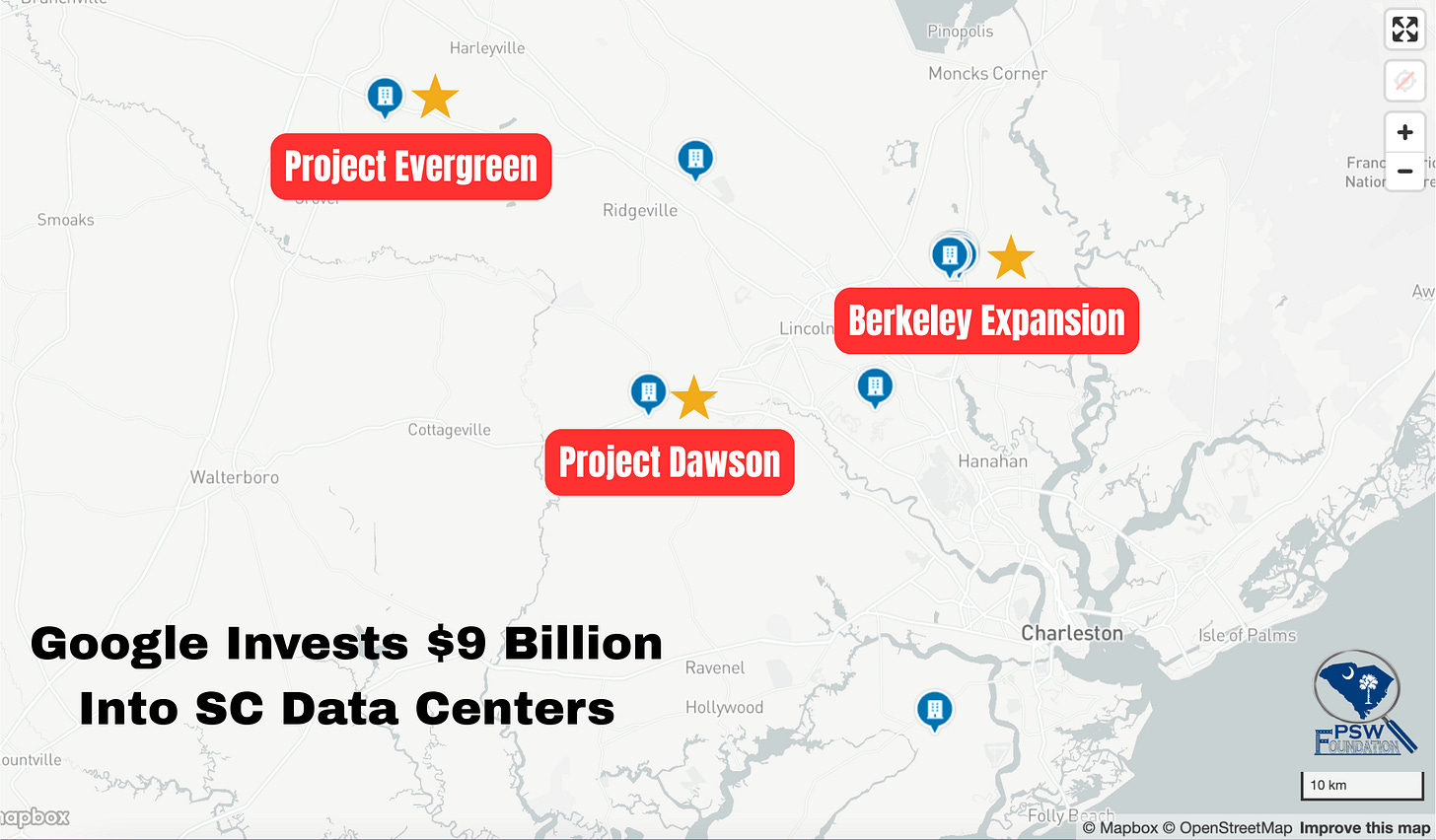
See the full interactive map HERE.
Google also used the aliases Project Evergreen and Gannett Enterprises LLC to purchase 206 acres for a third data center near Winding Woods Commerce Park outside of St. George. Google currently owns the Pine Hill data center that is located very close to Winding Woods. Furthermore, the county also agreed to sell the county-owned land at the Pine Hill location to Google for half of the price that was advertised on its website. The hot deal was sold to Google for $5.84 million which is around $21,760 an acre. While there are not many details, Google received “historic tax breaks from Dorchester County and a discount electricity deal from Dominion Energy” as reported by David Wren at the Post and Courier. As (another) added perk, the operator will receive a complete refund of taxes on personal property.
Maximum Hype, Minimal Jobs
The next few weeks and most likely into the new legislative session, you will see SC elected officials tout this “investment” as “economic growth” that will bring “new jobs." But just like the rest of these deals, it will cost South Carolinians everything, and give them next to nothing while giving away the farm.
As an example from another part of the state Meta/Facebook is planning an $800 million data center in Aiken County (specifically the Sage Mill Industrial Park in the Graniteville area) that is supposed to create 100 “operational jobs” and will be optimized for AI workloads. Which makes you wonder…how many jobs will there be when the AI dust has settled?
This seems to be another grossly misleading statistic, as many times a data center only requires 20-50 full-time staff positions (according to several different sources, averaging roughly around 30 jobs.)
Between the two new Google sites, there are a projected 200 new operational jobs that are supposed to be created.
Massive Energy Bill Passage Comes Back to Haunt SC
In South Carolina, major data center projects under construction already project the need for roughly 800 megawatts of power daily, which is enough to strain electric infrastructure. As a comparison, a single megawatt is enough to power between 400 to 900 homes in a year.
As Google builds and expands data centers in South Carolina, it will answer the prayers of power-hungry legislators who have been waiting to ramp up the energy infrastructure on the taxpayers’ dime, just like they did during the 2024-2025 legislative session that allowed ratepayers to be charged before state-subsidized nuclear construction was ever completed. This isn’t the first time that language has been added to a bill that ended in catastrophe that ratepayers are still paying off. In 2017, Fairfield County nuclear facility had a huge failure regarding VC Summer 2 and 3 reactors, resulting in bankruptcy, top officials going to jail, and the surrounding ratepayers flipping the bill eight years later. So what did our legislators do last year? Vote for it again by passing H.3309 that included the same language. How did they pass this? Legislators and power companies fear-mongered power brownouts, some in Republican legislators even stated its been happening (even though residents stated otherwise.)
As pointed out by the South Carolina Policy Council, language was removed (Section 44) from H.3309 by Representative Gil Gatch of Goose Creek that would have protected residential electricity customers from rate-hikes caused by data centers. 88 State Representatives followed suit and voted for this amendment, with only 13 voting against (only Democrats.) Check out how your representative voted HERE.
I, along with the South Carolina Policy Council (SCPC), and several other legislative watchdogs warned of this dangerous bill during the legislative session, yet it fell on deaf ears. I wonder why?
Data Centers Suck Local Resources
Data centers have become infamous suckers of local resources like water and energy. A 2024 study estimated that U.S. data centers consumed around 17 billion gallons of water directly for cooling in 2023, with projections indicating this could double or even quadruple by 2028.
For comparison, the average American family consumes around 109,500 gallons a year. If U.S. data centers only consumed 17 billion gallons of water a year, it would take the average American family over 155,000 years to consume the amount of water U.S. data centers used in a single year.
The United States has an estimated 4,200–5,400 active data centers, depending on how analysts define and count facilities. As of mid-2025, industry trackers show hundreds of U.S. data centers under construction and more than 1,500 announced or planned.
The current Google site located in Berkeley County is listed as the third most water-intensive among Google’s U.S. data centers, consumed over 763 million gallons in 2023. To keep up, Berkeley County and Charleston Water System are planning to supply an extra 5 million gallons per day to support the expansion. Of course, this will not be cost-free. Utilities must build pipelines, pumping infrastructure, and manage permit compliance whose price tag is often passed to the customers.
Currently, South Carolina law does not require public reporting on surface or groundwater usage from data centers so South Carolinians will have no way to verify whether they are being upcharged due to the data centers moving into their area.
SC Dept. of Commerce Rolls Out the Red Carpet
As we have learned through nearly every single deal South Carolina makes with a gigantic, global corporation, the SC taxpayer gets to foot the bill for everything. Just take a look at the Scout Motors/Volkswagen deal that is still raping the small town of Blythewood.
When you go to the South Carolina Department of Commerce website, they give you several ways that businesses can get around either corporate taxes or sales taxes for new move ins.
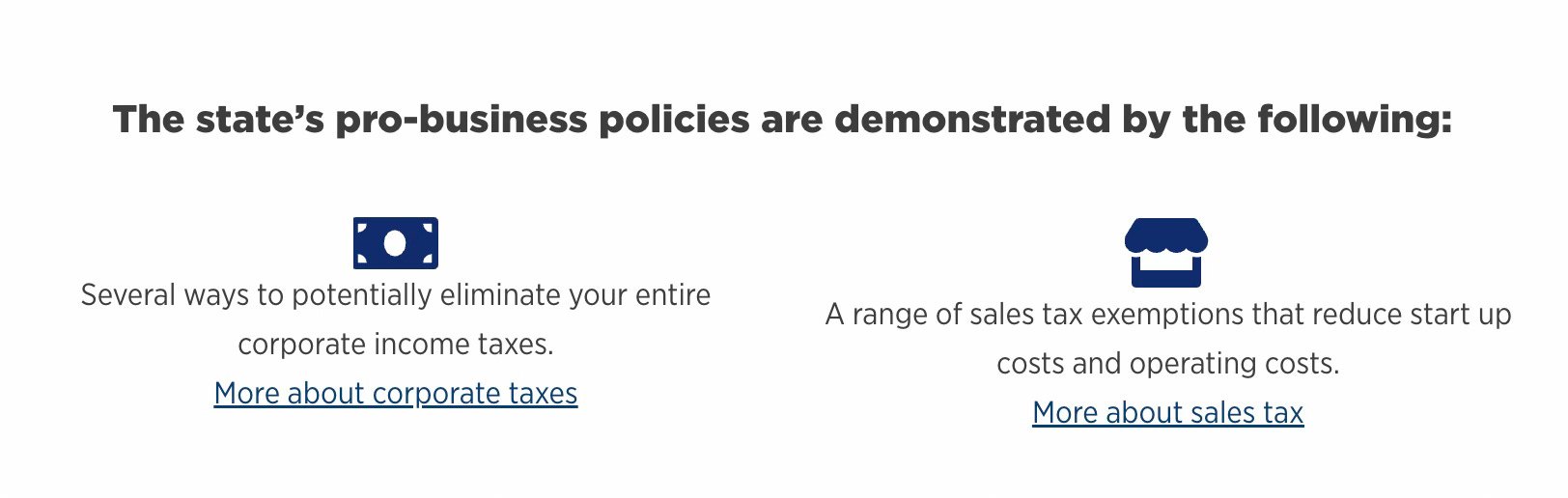
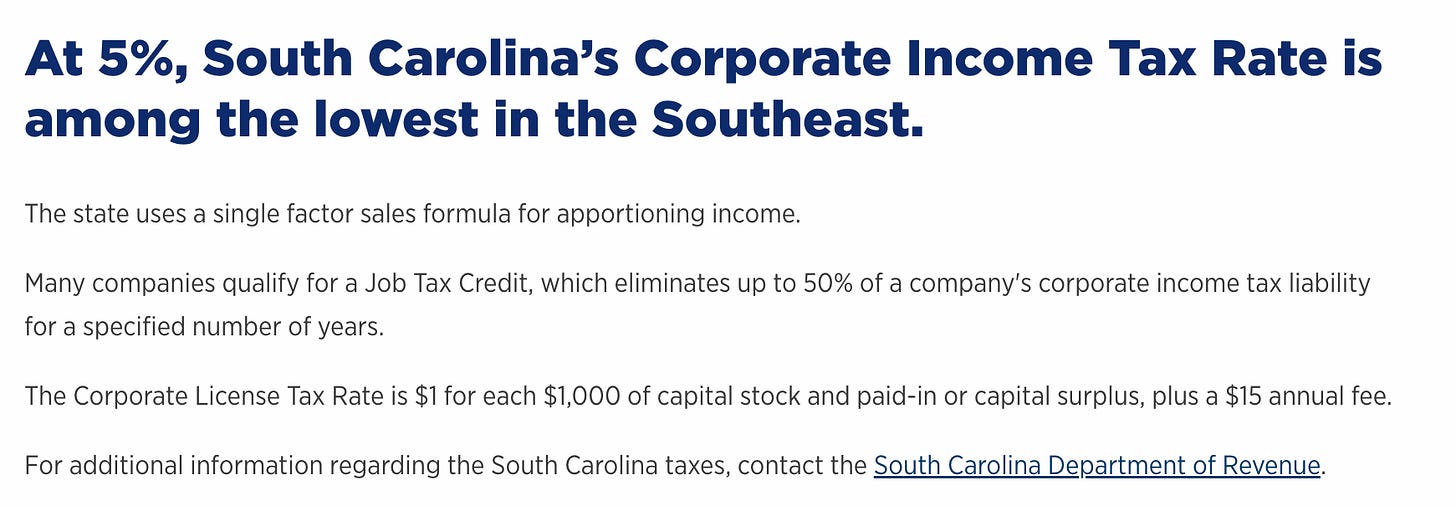
The SC Commerce website brags that South Carolina’s Corporate Income Tax Rate is the lowest in the Southeast, sitting at only 5%. On the other hand, South Carolina has the highest individual income tax rate in the Southeast, capping at 6.2%.
However, that 5% can be eliminated. That 5% corporate income tax is only placed on what is sold in South Carolina and the SC commerce’s website boasts that there are many “credits and methods to reduce and eliminate corporate income tax liability.” Employees' of these global corporations incomes will be taxed more than the income of the corporation itself.
Here’s the icing on the cake: these corporations are only charged sales tax on the good that are sold within the borders of South Carolina. Any goods sold outside of South Carolina are exempt.
FILOT Incentives
A Fee-in-Lieu of Tax (FILOT) agreement allows large corporations to drastically reduce their property-tax burden by lowering their assessment rate—often from 10.5% to 4%—and locking it in for up to 50 years, along with exemptions on equipment and personal property. According to analysis done by the South Carolina Department of Revenue and the South Carolina Policy Council, these incentives save major companies tens of millions in taxes while shifting more of the local tax load onto residents and small businesses.
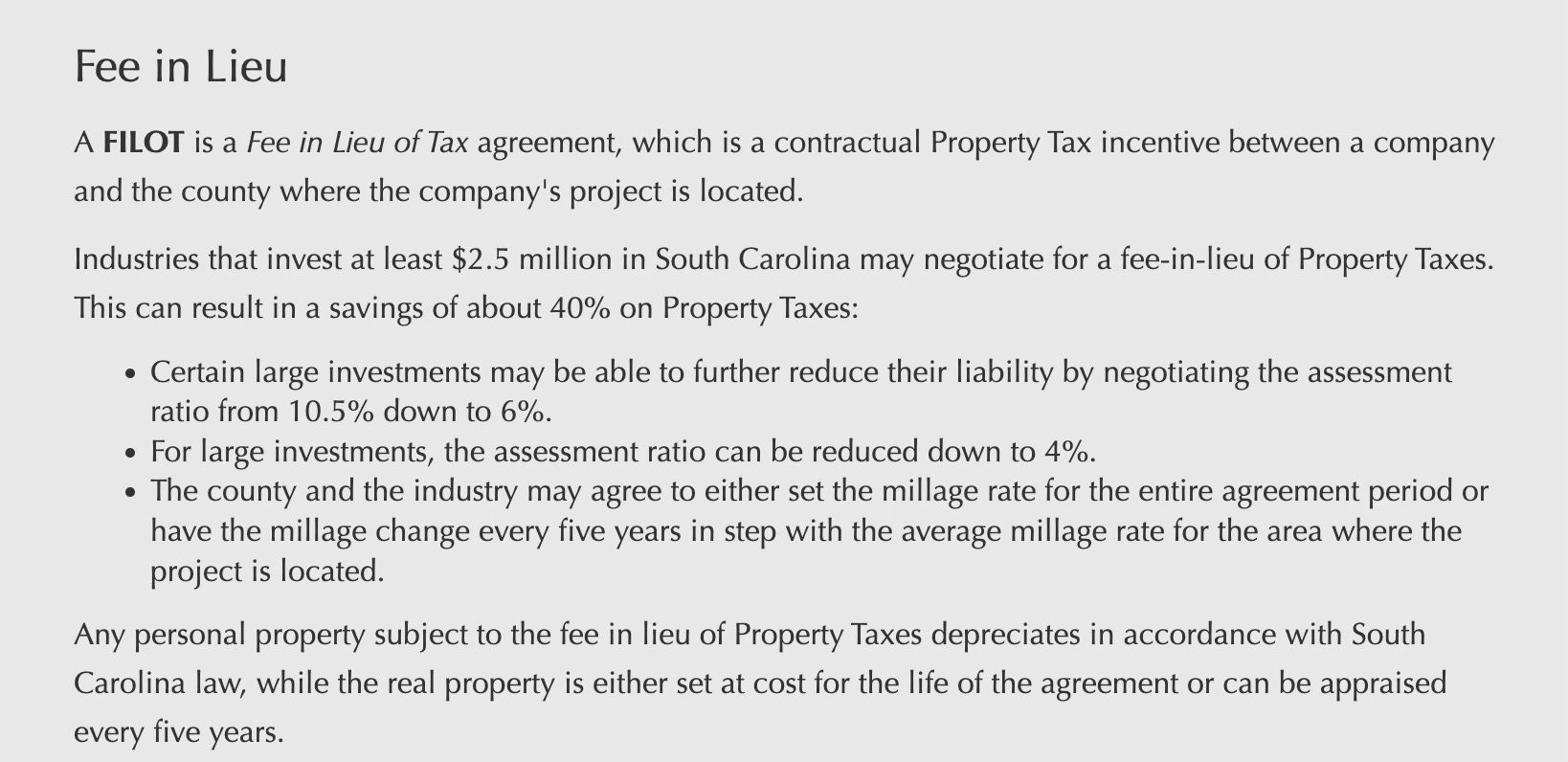
The South Carolina Department of Revenue website on Fee in Lieu of Tax agreements.
South Carolina’s “Fee-in-Lieu of Tax” (FILOT) program has once again been deployed to subsidize Google’s expanding footprint. In Berkeley County, Google’s FILOT agreement was formalized back in December 2010 and has remained in effect along with other added benefits. A review by Good Jobs First uncovered that in 2006, Google applied for subsidies under a shell company specifically created for expansion. The review goes into great detail and notes that some of Google’s campus paid a yearly property tax of $10 and that local subsidies are for 50 years.
It is important to note that none of the core financial terms are publicly available online and it does not appear that the terms were re-opened or renegotiated. That means that 15 years later, one of the world’s wealthiest corporations is still benefiting from a tax-cut deal made in 2010.
Dorchester County’s deals are even more opaque. While officials have loudly touted “historic tax breaks”, the county has not published a single FILOT ordinance or finalized fee agreement for either the Pine Hill or Winding Woods data centers.
What is known—from the county and through reporting from the Post & Courier—is that Dorchester approved a suite of incentives: steeply reduced property taxes through a FILOT-style arrangement, a full refund of personal-property taxes (meaning servers and equipment are effectively tax-free), a county land sale to Google at roughly half the posted price, and a preferential energy-pricing deal negotiated with Dominion. Public statements indicate Google may have been granted a 4% assessment ratio locked in for decades, but the actual contractual terms remain concealed behind codenames like “Project Dawson,” “Project Evergreen,” Autumn Timber LLC, Mallard LLC, and Gannett Enterprises LLC. If the agreements exist, they are either withheld from online posting or filed under these shell companies.
Other Incentives
As noted by the same report from David Wren, the proposed contract between the Dorchester data center and Dominion Energy gave a special “economic development rider” rate of 6 cents for every hour of power which is less than half of the 14 cents residential customers pay.
Most of the proposals, contracts, and packages are not publicly available which leads us to wonder how many incentives were Google and their shell companies given? We may never know, but it’s safe to say that all of the surrounding residents will end up paying for rate hikes, even if the data center decides to leave.
South Carolina is prostituting itself to these large businesses while their citizens and small, local businesses are getting the short end of the stick.
SC Politicians Get Involved
Lieutenant Governor and current gubernatorial candidate Pamela Evette celebrated Google’s announcement, stating that it will grow South Carolina’s workforce. “Google’s significant investment in our state represents a strong commitment to South Carolina’s growth and prosperity,” said Lieutenant Governor Pamela Evette. “This expansion will strengthen our workforce, prepare our people for the jobs of the future, and keep South Carolina at the forefront of AI innovation — creating a brighter future for all our residents.”
South Carolina Attorney General (SCAG) and another gubernatorial hopeful Alan Wilson has previously taken his own cut of the Google pie when he jumped on to a multi-state lawsuit suing the company and receiving a $7.8 million settlement in 2022. The lawsuit included allegations that Google was misleading users into thinking their location tracking was turned off when it was not.
“Economic Development” Sellouts
South Carolina leaders continue to market these massive data center deals as “economic development,” but the pattern is now unmistakable: global corporations walk away with unprecedented tax breaks, discounted land, cheap energy, and agreements that never see the light of day, while the public absorbs the costs in higher utility bills, strained infrastructure, and a shrinking tax base. When will legislators stop bending over backwards for multinational giants? Until that day, South Carolinians will remain the subsidizers, not the beneficiaries, of this so-called “growth.”
---------------------
Alaina Moore is Co-founder of Palmetto State Watch. Host of the Magnifying Glass Podcast. Contributing Editor with United Patriots Alliance.