








- Leadership - Desperately Needed!
- It’s Getting Late! It’s Now or Never
- Islamic Expansion in Texas
- Republicans Finding Common Ground
- Former Moms for Liberty Chairs in South Carolina Address Massive Departure from Organization
- Christopher Columbus - Little Known Part I
- Greenville County Holding Public Meetings on 1% Transportation Sales Tax Referendum
- Beyond the Monuments - Finding the Forgotten Grave of Dicey Langston
- The Myth of Voting for the Lesser of Two Evils
- 2026 Voting Information: Early Voting & Polling Locations
- Christopher Columbus - Little Known Part II
- Thurmond and Murkowski Won as Write-Ins. Is This Year’s Senate Race Really the Same?
- South Carolina Gas Tax Climbs From Near Bottom Nationally to 30th in 2026
- Equipping the Persecuted: Weekend Terror Alert Helped Avert Wider Massacre as Slaughter of Christians Continues to Ravage Nigeria Unchecked by Government
- Hunting Island's Lighthouse Was Built to Outsmart the Atlantic's Shifting Shoreline
Local Columnists
Are We Going To Let Moon Bats Destroy Us?
- Details
- By W.H. Lamb

We’ve all seen them in person or on video: Little flying mammals who come out around dusk in search of insects or fruit to eat. A few of them seek out animal blood to drink, and are called “vampire” bats. Most people are afraid of bats (which don’t get in your hair, as an “old wives tale” long has claimed), but except for the remote possibility of being bitten by a rabid bat, they are harmless to humans and generally are beneficial to mankind. All except one.
DO YOU KNOW ANY “MOON BATS”?

Do Creationist Arguments Result from Incredulity or Agency Detection Bias
- Details
- By Charles Creager, Jr.
The claim has been made that creationist arguments result from either incredulity or agency detection bias. This claim is primarily a way of dismissing any argument that would infer a designer Regardless of the nature of the argument. The insistence of this problem is never made with a reasonable explanation, the person making it simply continues to insist on the fallacy or bias.
Incredulity fallacy
An argument from incredulity Claims that an idea has to be false because it contradicts the person's personal beliefs, or that they cannot imagine that it is true. It can also take the opposite form of making the case that an idea has to be true for the same reasons. The problem with this fallacy is the fact that personal belief does not in and of itself mean that something is true or false.
Problems with the Idea of Apparent Age in Young Earth Creation
- Details
- By Charles Creager, Jr.
One of the ideas claimed as a way of explaining how an Earth that is 6000 years old can be dated at billions of years old and for explaining how we can see distant starlight is the idea that God created the earth and the universe with apparent age. There are, however, multiple problems with this idea. Please note, this is not to be confused with a mature creation, where God created things with what might be called functional age. For example, God would have created Adam and Eve as fully functional adults. The same would be the case for plants and animals as well. However, what the apparent age idea proposes is that God included needless artificial age.
Top 20 Nations Ranked by 2025 GDP (PPP)
- Details
- By Mike Scruggs
Competing in a Changing World
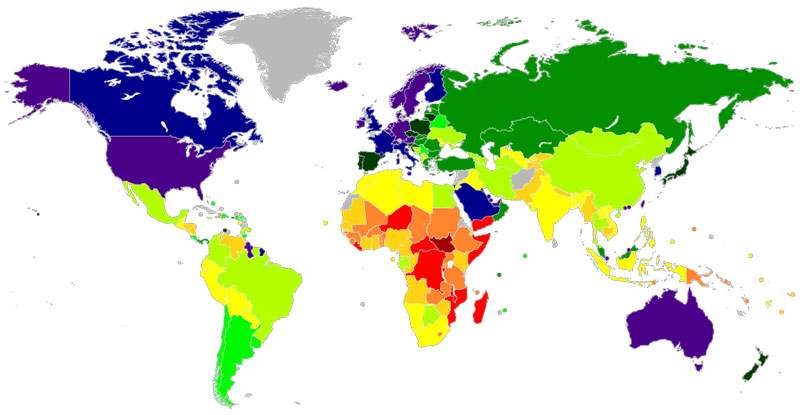
In economics, annual Gross Domestic Product (GDP) is the total monetary value of all final goods and services produced within a country's borders over a year. It serves as an indicator of a nation's economic performance and size. GDP (PPP) is the Gross Domestic Product based on Purchasing Power Parity (PPP). PPP adjusts GDP for the relative cost of local goods, services, and inflation rates for each country, which makes it a much more useful and realistic calculation than using exchange rate calculations for a theoretical international dollar. Several international organizations calculate GDP—The International Monetary Fund, The World Bank, and CIA—and arrive at slightly different figures. The World Bank and IMF figures are generally close. CIA estimates may be politicized. The statistics presented here are from the International Monetary Fund (IMF) based in Washington. The United States is used as the comparison standard so the GDP and GDP (PPP) for the United States are the same. These are the most recent estimates for calendar year 2025.

Are Your Memories Fading Away?
- Details
- By W.H. Lamb

We all have them—memories, that is. Inevitably, some of them may fade with the passing of the years because nature is often cruel as our brain cells succumb to time’s attacks. But many of our precious recollections of the past—of our “good old days”-- stay with us for a lifetime. This truth was emphasized to me several years ago when, on a local radio station, I listened to what I believe to be one of the most beautiful and haunting secular songs I’ve ever heard. It brought tears to my eyes then, not so much for any memories it stirred in me, but for the depth of emotion projected by the man who was singing it.

What if We Find Life Elsewhere in the Solar System
- Details
- By Charles Creager, Jr.
At this time the probe, known as Europa Clipper, is on its way to Jupiter. Its mission is to make repeated close-up observations of Jupiter's moon Europa. One of the reasons for this mission is the hope of finding evidence of life on the small moon. It is thought that there is probably a surface ocean underneath the ice that makes up Europa surface. This is suggested by the cracks and other features that are found across Europa’s surface.
The question before us here is what the consequences from a creationist perspective would be if life was discovered on Europa or any other object in the solar system. The response of evolutionists is obvious and in fact it has already been indicated. If we find any life within the solar system, they will immediately conclude that it is evidence that abiogenesis is very common. However, there are two possibilities that a creationist perspective offers, that would have no effect whatsoever of supporting any possibility of abiogenesis.
National Debt to GDP Ratios Survey
- Details
- By Mike Scruggs
History and Common Sense Warning Signals

Spanish- born philosopher and essayist George Santayana (1865-1952), in his 1905 volume, Reason in Common Sense, is especially remembered for these words: “Those who cannot remember the past, are condemned to repeat it.” This is often phrased more pointedly: “Those who cannot learn from history are doomed to repeat it.”
In June 2025, the US national Debt was $36.2 Trillion, and its annualized GDP was $30.3 Trillion. This is a ratio of slightly over 119 percent.
In economics, annual Gross Domestic Product (GDP) is the total monetary value of all final goods and services produced within a country's borders over a year. It serves as a crucial indicator of a nation's economic performance and size.

- Now We Must Ask: ‘QUO VADIS” America?
- Mainstream Media Lies about Project Ukraine
- What’s A Billion? It Depends on What You Are Counting
- Top 10 Successful Young Earth Creation Predictions that Result Directly from What is in the Bible
- Pursuing Peace—The Alaska Summit
- Sergei Rachmaninoff: The Soul of a Musical Master
- Creationists or Evolutionists: Who Really Ignores Evidence?
Subcategories
Browse by the Top Tags ...