








A Cautionary Tale of Tariff Economic and Political Dangers
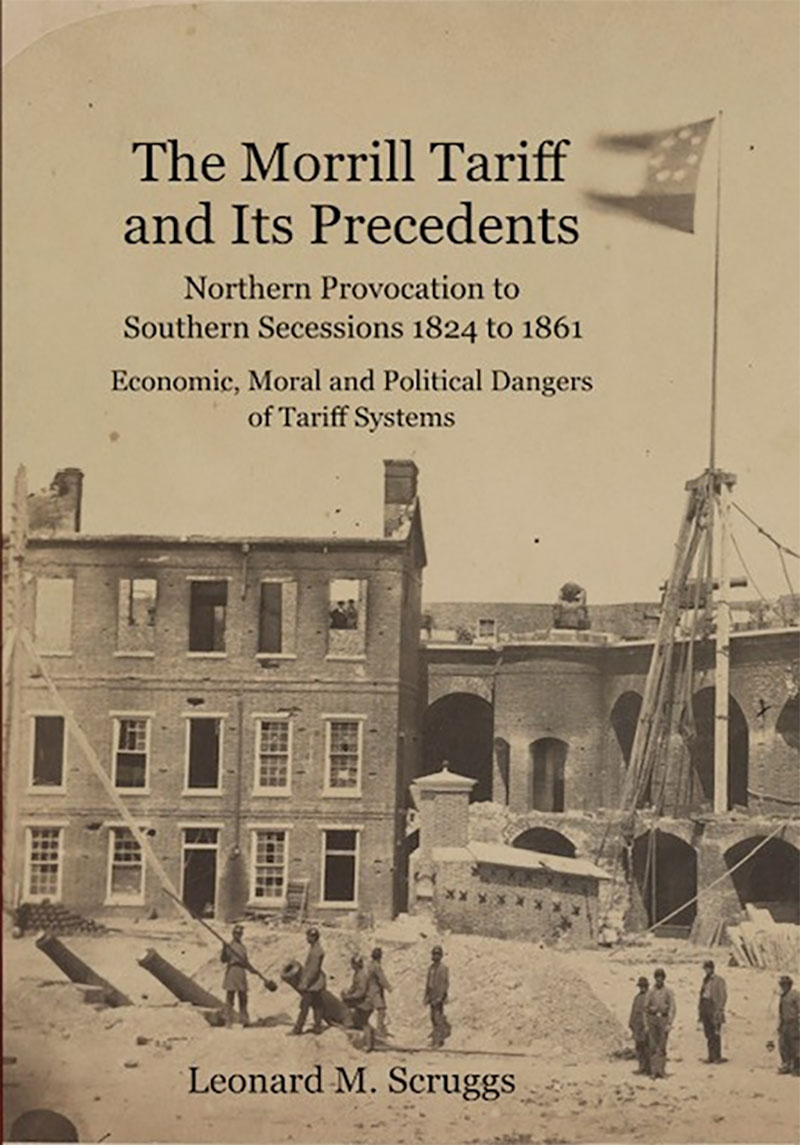
I am using this article to introduce my new book:
The Morrill Tariff and Its Precedents: Northern Provocation to Southern Secessions 1824-1861; Economic, Moral and Political Dangers of Tariff Systems—Leonard M. Scruggs.
There are many strong reasons why these issues are both historically and currently important.
My new book and this short article primarily address the underlying economic causes that led to Southern State Secessions in 1860 and 1861, but it is a cautionary tale regarding present US Tariff Policy and its appropriate legislative and executive administration.
It also addresses the relative importance of slavery versus tariff policy as underlying causes of the Civil War. For most Northern politicians, the slavery issue was not about freeing slaves; it was about restricting slavery to its largely Southern domain and prohibiting it in new territories and states. In recent decades especially, slavery as a cause of the war has been exaggerated, and tariff policy as a cause has been suppressed.
Beginning in 1789, about 95% of U.S. tax revenue had come from tariffs. This Federal revenue tax burden was generally less than 10% until some industrial protectionism was introduced in 1816. This was so successful and profitable for industries benefiting from it that they wanted more. This was the beginning of Northern industry’s addiction to high protective tariffs. Henry Clay’s 1824 Tariff increased tariffs on dutiable goods to near 30%. This benefited Northern industry at the expense of consumers, both public and business, agriculture generally, and especially exporters. In 1860, the South accounted for 82% of U.S. exports. Cotton, alone, accounted for over 58% of U.S. exports. Southern agricultural interests, epically cotton producers, reacted with strong denunciations, including talk of secession among its political leaders.
Henry Clay’s American System of protectionist tariffs, introduced in 1824, began a 37-year tariff war between North and South, culminating in the Morrill Tariff in 1861, which would increase effective ad valorum tax rates by 67% beginning in April 1861 and almost tripling the effective ad valorum rates within three years.
The British were important and supportive promotors of free trade and antagonistic to American protectionist tariffs during the Civil War era. Hence British support for the Confederacy was high, although the British were consistently anti-slavery. However, many prominent British business and political leaders and prominent journalists and authors believed and frankly stated that the American Civil War was primarily about tariffs and not slavery, the slavery issue being hypocritical “humbug.”
Between Clay’s 1824 Tariff and the Morrill Tariff, the Tariff War went back and forth from low tariffs facilitating free trade to high protective tariffs favoring Northern industry but dealing hardship to consumers, unprotected industry, and especially to exporters.
The ultra-protectionist Tariff of Abominations with dutiable tariff rates over 50% came in 1828, and the so-called relief Tariff of 1830 gave little relief to the South. Southern political leaders concluded from it that Northern politicians were focused only on Northern prosperity and Northern political dominance alone and had little interest in the consequences suffered by Southern states. Remaining in such a union would suffocate Southern rights, prosperity, and liberty. This caused the Nullification Crisis of late 1833, when South Carolina declared the 1828 and 1830 tariffs unconstitutional. President Andrew Jackson, although anti-protectionist, threatened to enforce the tariffs with military force. In response, South Carolina mobilized 27,000 militia troops for secession and war. The Compromise Tariff of 1833 was worked out by Senator (elected 1831) Henry Clay of Kentucky and South Carolina Senator John C. Calhoun, recently Jackson’s Vice President. Under the new 1833 law, tariffs were to fall back to near free trade levels within a decade.
However, Northern industrialists made another try for protectionism, passing the “Black Tariff” of 1842 with tariffs averaging close to 40% considering additional costly and burdensome administrative costs. The tariff burden was so onerous that imports fell roughly 50% resulting in tariff revenue declining as much. The Walker Tariff of 1846 rolled back dutiable rates to about 25%, and the 1857 Tariff rolled back the rate on dutiable goods to 15-24%, almost at free trade levels. Dutiable rates below 10-15% were considered in the free trade range. The Confederate Constitution of August 1861 prohibited protectionist tariff rates and policies.
The Morrill Tariff was introduced in the U.S House of Representatives in 1858, and after much political struggle was finally passed by the House on May 10, 1860. The Morrill Tariff was a protectionist tariff that would benefit Northern industry at Southern expense. The South already bore more than 80% of the tariff burden and benefited from less than 25% of government spending. At this point, the die was already cast for South Carolina, Georgia, and the five other cotton-producing Gulf states. Seven states had already seceded when the Morrill Tariff was passed by the Senate on March 2, 1861, and signed into law the same day by President James Buchanan, two days before Lincoln’s inauguration on March 4. Lincoln supported the tariff and promised to enforce it in his inauguration speech, which further provoked Southern anxieties.
Henry Clay’s Whig Party with its American System of protectionist tariffs and corporate subsidies had all but collapsed by 1854. The Whigs were replaced by the Republicans in 1854, who were determined to restore the American System and high tariff protectionism and increase both dutiable tariff rates and expand the products subject to dutiable tariffs.
Democrats have generally resisted protectionist tariffs throughout American history. However, beginning with President Dwight D. Eisenhower in 1953, Republican presidents also favored free trade and low tariffs. Since the early 1960s, there has been a growing Libertarian trend in the Republican Party. Moreover, in the South, as the national Democratic Party began to be too liberal for Southern voters, conservative Republicans began to replace them. Most conservative Southern Republicans were wary of big government-big business economic strategy, including protective tariffs that hurt Southern agriculture and might hinder the South’s expanding new manufacturing and other commercial export opportunities.
High tariffs continued during and after the Civil War, thus hindering Southern economic recovery and growth and keeping the South impoverished. Republican President William Howard Taft, however, serving from 1909 to 1913, saw the need for low tariffs, but he was only able to get the dutiable rates down from 46% to 41%. Under Southern Democrat President Woodrow Wilson elected in 1913, the Underwood Tariff Law began to lower tariffs. Dutiable tariff rates were down to 33% in 1914 and down to 16% by 1919. Wilson also reduced the number of products subject to import duties dramatically. This was a 65% reduction in effective tariff burdens. Tariffs began to rise again in 1921.
In 1930, at the beginning of the Great Depression, when unemployment had already risen to 7.8%, the Smoot-Hawley Tariff raised average dutiable tariff rates to a peak in 1932 at 59.1%. Exports, which were doing relatively well until the tariff, now suffered a 61% drop. The Great Depression was thus made much worse with unemployment peaking in 1933 at 24.9%. Smoot-Hawley passed the House 264 to 147 and the Senate 44 to 42. Only 20 Democrats in the House and 5 Democrats in the Senate voted for it. At that time, the Democrats were still largely conservative and populist. Most of the Republicans were still largely following the Whig Party American System of high protective tariffs and big-business orientation that was adopted by the Republican platforms of 1856 and 1860.
The book also exposes many contradictions to the commonly believed notion that the Civil War was primarily about slavery. The Republican slavery objection was mostly about limiting slavery to the South. It was not a noble crusade to end slavery. That political invention came late in the war and really after the war. Moreover, statements by Lincoln, his Chief Economist Henry Carey, Republican Congressional leader Thadeus Stevens, and British officials and public figures indicate that maintaining high protective tariffs was considerably more important to the Lincoln government than changing the status of slaves. Again, more than 80% of the tariff burden fell on Southern importers and consumers and, in addition, injured Southern export revenues and profit margins.
Northern States benefited from the tariff at the cost of substantial Southern economic suppression. That drove the South toward independence, which would have fearful economic consequences to the North. The Northern War against the South was about preventing Southern Independence. Slavery just sells better emotionally to justify a war that took as many as 800,000 lives and impaired the Southern economy and future prospects for another half-century.
There would probably never have been a Civil War had it not been for the Morrill Tariff. The Morrill Tariff itself, however, was the culminating effect of a 37-year North-South economic Tariff War from 1824 to 1861. Its terrible aftereffects extended through the Civil War until the Wilson-Underwood tariff Law in 1913.
Tariffs began to rise again in 1921 with the election of Republican Warren Harding. Following World War II, average dutiable tax rates fell to under 14% under Conservative Missouri Democrat Harry Truman. They remained low under Republican Dwight Eisenhower 1952-1961 and under both Republican and Democrat administrations thereafter.
From 1980 through 2025, dutiable tariff rates averaged less than 6% and tariff revenues less than 4% of total imports. Tariffs and tariff rates are a cautionary tale. There are appropriate tariffs, and there are dangerous tariffs, and even appropriate tariffs have a cost to American consumers and exporters that must be carefully considered. It is a warning shadow over the Trump Tariffs of 2026.
The book also contains 57 historical photos, paintings, images, political posters, and political cartoons illustrating the importance of tariff economics, tariff politics, and tariff suffering from 1824 to 1913 and later during the Great Depression from 1930 to 1939.
 Mike Scruggs is the author of two books: The Un-Civil War: Shattering the Historical Myths; and Lessons from the Vietnam War: Truths the Media Never Told You, and over 600 articles on military history, national security, intelligent design, genealogical genetics, immigration, current political affairs, Islam, and the Middle East.