







Part 4 of the Persian Gulf and Red Sea Nations
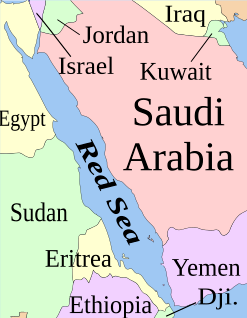
Sudan, Egypt, Jordan, Israel
The Republic of Sudan
Sudan is a country in northeast Africa with 465 miles of coastline on the Red Sea. Sudan’s population was 52 million in 2025. Geographically, it is the third largest nation in Africa. It borders seven countries: the Central African Republic on its southwest, Chad to its west, Libya to the northwest, Egypt to the north, the Red Sea on its east, Eritrea and Ethiopia, to its southeast, and South Sudan on its south. Sudan is 97% Sunni Muslim with a small 3% Christian minority. About 70% of the population are Sudanese Arabs, About 28% are spread over dozens of tribes. The official languages are Arabic and English. Its famous capital of Khartoum has a greater metro population of 7.1 million. Khartoum is at the confluence of the White (western) Nile and the Blue (eastern) Nile and figured prominently in British administrative rule and British-Arab conflicts.
South Sudan
Note that South Sudan is a separate land-locked country with a 12.7 million population of Nilotic and East African peoples. South Sudan seceded from Sudan in 2011, largely because of religious and ethnic marginalization and control of natural resources. The White (western) Nile passes through South Sudan and by Juba its capital. The South Sudan population is 61% Christian, 6% Muslim, with the rest devoted to native religions. Over 70 government recognized native languages are spoken there, but the most common recognized native language is Dinka, spoken by about 40i% of South Sudanese. However, English is the only official language. The Dinka are unique in that they are typically very tall and very linear, and their predominate male DNA branch, A1B1-M118, is one of the most ancient known. All male human DNA carries the Branch (haplogroup) A genetic markers. South Sudan has considerable proven oil reserves and many other valuable natural resources but is one of the least developed and poorest countries in the world. Existing oil production is the main source of government revenue, while the economy is predominantly agricultural. South Sudan’s proven oil reserves are about four times that of Sudan. However, its oil revenue is dependent on Sudanese pipelines, refineries, and Port Sudan on the Red Sea. South Sudan’s government is essentially dominated by a Presidential autocracy.
Sudan History and British Connections
Sudan was a British protectorate (Anglo-Egyptian Sudan) from 1899 to its independence in 1956. In the Bible, Sudan was referred to as Cush or Nubia. Cush was the son Ham and the source of Hamitic languages and peoples. Winston Chruchill was a British cavalry officer in 1898 and 1899 during the 1896 to 1899 British and Egyptian reconquest of Sudan. His absorbing and colorful account of it, The River War, published in 1899 and revised ind1902, brought him fame in Britian as a war correspondent. The overall commander of British forces in Sudan was Major General Herbert Kitchener, who later rose to the rank of Field Marshall and then British Secretary of War in the early years of World War I, being killed in action in 1916 with the loss of the HMS Hampshire near Orkney, leaving for a special diplomatic mission to Russia at its arctic port of Arkhangelsk,
The Sudan Civil War 2023 to present
Since April 2023, there has been a civil war in Sudan. There are two primary opponents and some minor ones. The primary opponents are factions of Sudan’s military government. The internationally recognized government of Sudan is controlled by the Sudanese Armed Forces (SAF) commanded by General Abdel Fattah al-Burhan. The SAF is opposed by the rival Government of Peace and Unity and the Rapid Support Forces (RSF), paramilitary forces led by General Muhammad Hamdan Dagalo. Smaller armed groups splintered from the Sudan Liberation Movement have also taken part on both sides. These have also overlapped into internal conflicts in South Sudan. Foreign influence in Sudan is rampant. The United Arab Emirates (UAE) has been the most involved and supports the RSF. Egypt, Iran, and the United States support the SAF. The Russians intially supported the RSF with Wagner Group forces, but has switched to SAF support. Chad supplies the RSF.
The context of the present civil war is heavily influenced by continuous civil wars from 1955-1972 and 1983-2005. In the Darfur region in 2003-2005, an estimated 200,000 non-Arabs were slaughtered by rebel forces. In the present conflict, tensions and casualties frequently result from ethnic, tribal, and religious competition and control of resources, especially oil. South Sudan is experiencing violence and potential civil war spilling over from Sudan’s civil war factions.
At least 150,000 have died in the latest civil war beginning in 2023. (Some estimates run as high as 400,000) Probably more than 60,000 were the result of military conflict. The rest were from starvation and health issues. Close to 6.0 million people have been displaced, and in some regions 35% of the children suffer from significant malnutrition.
Sudan’s estimated 2025 GDP-PPP was $118 billion, 98th in the world. It’s per capita GDP-PPP is only $2,034, 175th in the world.
Sudan has five major ports on the Red Sea, but by far the most important is Port Sudan, a city of about 400,000, which has an oil refinery and is the primary gateway for 90% of Sudan’s international trade. There is a 720-mile oil pipe-line connecting Khartoum and Port Sudan. Of increasing importance is the port of Marsa Bashayer, about 15 miles south of Port Sudan, which specializes in petroleum products.
The Arab Republic of Egypt
The population of Egypt in July 2025 was 107.9 million, the 15th largest in the world. Egypt is between 85-90% Muslim, of which the overwhelming majority are Sunni Muslims. The primary and official language is Arabic. Egypt is the original home of the fundamentalist Sunni Muslim Brotherhood. Egypt, however, has the highest Christian population in the Middle East and North Africa. It is estimated to be at least 10% and as much as 15% Christian. About 90% of these are Coptic Orthodox Christians. All Christians in Egypt face both official and informal discrimination, yet they have endured.
Egypt’s Red Sea coast stretches over 500 miles from the Suez Gulf to the Sudan border. The Suez Canal, of course, is vitally important to international trade. The 110-mile canal connects the Mediterranean Sea with the Red Sea through the Suez Ismuth, dividing Africa and Asia, and the main part of Egypt from the Sinai Peninsula. The Suez Canal is the primary trade connection between Europe and Asia.
Egypt’s GDP-PPP is $2.6 trillion, the 18th largest in the world, and the second largest in Africa. Per capita that is $23,321 annually, the 87th in the world. International trade accounts for 40% of the Egyptian economy. Egypt has the largest manufacturing sector in the total African economy, accounting for 22% of the total. Chemical industries, including petroleum products, alone are 12% of the Egyptian economy. Egypt’s steel production is the greatest in Africa and ranks 20th in the world. Egypt ranks 28th in proven oil reserves and 25th globally in oil production but is a net oil importer. However, it is rich in natural gas reserves, ranking 16th globally in proven natural gas reserves and 11th in present natural gas production. Egypt supplies 45% of Africa’s gas-fired electricity. Egypt has a substantial agricultural industry, but it relies on imports for 45% of its needs—primarily wheat from Ukraine and Russia.
Egypt was the center of the Arab Spring revolutions and uprisings against incumbent governments in 2011. Besides Egypt, this involved Tunisia (the first), Syria, Libya, Yemen, and Bahrain. These were not in my opinion spontaneous embracing of democratic government. They were largely orchestrated by the Muslim Brotherhood in Egypt to remove Muslim leaders whose relatively moderate Islamic governments were not sufficiently Salafist (fundamentalist) enough to match Muslim Brotherhood strict ideological and Islamic objectives in the Middle East. The Muslim Brotherhood is the largest and most powerful Muslim multi-national organization in the world. In 2004, the FBI discovered Muslim Brotherhood strategic plans to overthrow the U.S. government and replace American culture. However, the Unted States under the Obama Administration seemed to mold its Middle Eastern foreign policy to Muslim Brotherhood Salafist and political objectives.
The U.S. was essentially duped into the Syrian War to overthrow the Middle East’s most moderate Muslim leader, Bashar al-Assad, whose moderate Alawite Shia Muslims had aligned with and protected Syria’s large 10% Christian minority. According to Richard Ghazal, in The Hill, published 07/07/2025, the Christian minority is now less than 2.0%. What happened to more than 1.6 million Syrian Christians? Israel joined the U.S. in this war against Syria to achieve its own territorial and political ambitions.
Muslim Brotherhood leader Mohamed Morsi was elected President in June 2012, replacing long-time American ally Hosni Mubarak. Morsi was removed in July 2013 by U.S. ally General Abdel Fattah el-Sisi. Under Sisi, Egypt has taken a moderate foreign policy approach to Israel as encouraged by the U.S. However, Sisi is in a precarious political position because of substantial Egyptian public disapproval of Israel’s actions in Gaza that have resulted in disproportionate deaths of women and children, estimated by UN Women at 38,000.
Egypt is Africa’s leading military power and ranks 19 of 145 nations evaluated by Global Firepower 2026 reviews. It has 332 fixed wing combat aircraft and 348 helicopters. It has over 600 medium range missiles and active armed forces of over 438,000 and nearly 500,000 active reserves. Its Navy includes 20 major surface combat ships and 8 submarines. Egypt’s population and total available military manpower are more than ten times that of Israel, which has active armed forces of about 169,000. Egypt and Israel share a 165-mile border.
The Hashemite Kingdom of Jordan
Jordan has only 17 miles of coastline on the Red Sea. This is in the southwestern part of the country where the Gulf of Aqaba separates Jordan from Egypt. Jordan is a minimal factor in oil and gas proven reserves and production. Its only port, Port Aqaba (population 149,000), however, is the second busiest container port on the Red Sea. Jordan is bordered by Israel along the Jordan River, Syria, Iraq, and Saudi Arabia. It is 95% Arab and 95% Sunni Muslim. Its official language is Arabic.
Jordan’s population in 2023 was 11.5 million. Its capital is Amman with 1.8 million people. Its GDP-PPP was $132 billion. per capita $12,809. Jordan is 4 times larger than Israel, and slightly larger than the state of Maine. Jordan has a small active army of just over 100,000 with 65,000 reserves.
Jordan is one of the most water-scarce countries in the world. Its two largest economic sectors are industrial, including mining, with 26% and construction with 16%. Its communication and technology sector has 12%, but is by far the fastest growing. One strategic political factor is that Jordan creates 75% of the Arabic content on the internet.
Jordan is a semi-constitutional monarchy ruled by King Abdullah II. Its Prime Minister is Jafar Hassan. Jordan’s foreign policy is pro-Western with close relationships with the U.S. and UK. Jordan, Egypt, and the UAE, have also signed peace treaties with Israel.
Israel
I have written four articles on Israel in the last 3 years, which can be found in the online Times Examiner using their home page search engine: Welcome - The Times Examiner, and I plan to write an Israel-Iran update soon. In this Red Sea article, I will only update some related big picture information and statistics.
Wikipedia has Israel’s 2026 population at 10.15 million, but some reports claim that about one million of that population has already fled the country because of the war. The conditions have gotten worse lately as there are several credible claims that 80% of Iranian missiles are now getting through Israel’s Iron Dome defensive missile systems. The fact that the Israeli government has forbidden internet or other distribution of videos showing Iranian missile damage lends some credibility to deteriorating safety and living conditions for the civilian population.
Israel’s 3 largest cities are Jerusalem (the capital) with over 1.0 million people, Tel Aviv with 495,000 people and Haifa with 290,000 people.
The official language of Israel is Hebrew, but Arabic is recognized, and English is common. Israel is about the same size as New Jersey. Iran is 75 times as large as Israel, which is a considerable disadvantage for Israel militarily.
Only 72% of Israel’s population are Jews. Twenty-one percent are Arabs, and 7% or something else. About 74% of Israelis identify with the Jewish faith, while 18% claim Islam, and under 2% claim Christianity. Some 1.6% claim to be Druze, and various other faiths or no faith claims leave 4.5%. About 4.0 million Jews in Israel have a Russian immigration background. About 45% of the Jewish population are Ashkenazi Jews with a central or eastern European origin.
Oil and gas reserves and production are minimal in relation to other Middle Eastern sources.
Israel’s 2026 GDP-PPP is $609 billion, 50th in the world, per capita $59,095, 35th in the world.
Israel has the highest proportion of scientists, technicians, and engineers per 10,000 population in the world.
Israel has three main ports: Haifa and Ashdod on the Mediterranean Sea and Eilat on the Red Sea. Both Haifa and Eilat have been subject to significant missile damage.
Global Firepower 2026 indicates Israel is the 15th most powerful armed forces in the world. Iran is ranked 16th. The U.S. is ranked first, but Russia ranks second, and China ranks third. The Military-Industrial Power (MPR) rankings for 2026 are, however, Russia first (2103 score), China second (2014), the United States third (1904), Iran 11th (1333), and Israel 14th (1137).
Most of the U.S. media stick to a political narrative that limits informed understanding of the Iran War
“My people are destroyed for lack of knowledge…”—Hosea 4:6.
 Mike Scruggs is the author of two books: The Un-Civil War: Shattering the Historical Myths; and Lessons from the Vietnam War: Truths the Media Never Told You, and over 600 articles on military history, national security, intelligent design, genealogical genetics, immigration, current political affairs, Islam, and the Middle East.