








From Erik the Red to Pituffik Space Base
If you look at a global map centered on the North Pole, you will notice that Russia has the largest exposure to the Arctic Ocean, nearly 50 percent. Advancing technology or warmer climate could result in more viable Arctic seaports and trade passages to both the North Atlantic and Northwest Pacific, cutting down the time and possibly the cost of shipping goods. The United States, especially Alaska, Canada, and the Scandinavian countries could also benefit from such expanded, shorter, and cheaper trade routes.
Moreover, according to the U.S. Energy Information Administration, resource basins within the Arctic Circle (North of 66.5 Latitude) contain 13 percent of the world’s undiscovered oil and 30 percent of the world’s undiscovered natural gas. Currently, developing these resources would cost 50 to 100 percent more than in Texas, but technologies to reduce costs are developing rapidly. The Russians and others are pouring investments into Arctic infrastructure and extraction technology. The Arctic resource basins are also rich in phosphate, bauxite (for aluminum), iron ore, copper, nickel, diamonds, gold, zinc, and palladium.
Fisheries in the Arctic are especially productive. The fishing industry is Greenland’s principal economic income. The Arctic holds over 20 percent of the world’s fresh water. More than 10 percent of the world’s fresh water is in the Greenland icecap alone.
The Russian Federation is moving full speed toward Arctic trade dominance. According to the U.S. Coast Guard, Russia has 57 icebreakers and another four planned. Nine of these are the largest class of nuclear icebreakers. They are also developing a fleet of transports with icebreaking capability.
According to the U.S. Coast Guard, the U.S. has five icebreakers and another three planned. Currently, the Coast Guard operates only three polar icebreakers—the heavy duty Polar Star, the medium icebreaker Healy, and the recently acquired and refurbished medium icebreaker Storis. These are capable of supporting both Arctic and Antarctic missions. Another three are planned.
Canada has 9 operational and 5 planned small to medium icebreakers. Finland is third with 10 small to medium icebreakers, and Sweden has 8 small to medium icebreakers with another two planned. Denmark, whose territory includes Greenland and the Faroe Islands has four small icebreakers. Even China, which has no Arctic borders has four icebreakers, anticipating use of the Arctic trade routes. Norway has two medium-sized, high quality icebreakers, which have already set some Polar expeditionary records. The bottom line is that Russia is far and away dominant in numbers and icebreaker technology, while even China is expanding its capability. The Canadians are a distant second to Russia but increasing their fleet. The combined Scandinavian nations currently have better numbers and technology than the U.S.
The Arctic Council of eight Arctic-border nations was established in 1996. It is the leading intergovernmental forum promoting cooperation, coordination and interaction among the Arctic States, Arctic indigenous peoples, and other Arctic inhabitants on common Arctic issues, including sustaining a healthy and economically viable environment. The Arctic Council governing members are Canada, Denmark (including Greenland), Finland, Iceland, Norway, the Russian Federation, Sweden and the United States. Chairmanship is rotated every two years. Denmark holds the chairmanship until 2027. There are 14 non-Arctic observer members, including China. The Council requires unanimous decision for recommended actions but has no authority for enforcement. It is also up to each nation to fund whatever improvements are envisioned.
Of the four million inhabitants of the Arctic, about 500,000 are indigenous peoples. The six largest have permanent advisory membership: the Aleuts, Athabaskans, Gwichyins, Inuits, the RAIPON (Russian Association of indigenous Arctic peoples), and the Saami in northern Norway, Sweden, Finland, and the Murmansk/Kola Peninsula of the Russian Federation.
In addition to the 14 non-Arctic Observer Members, there are 25 supporting scientific, economic, geographical, climate, geological, and social organizations. The Arctic Council also sponsors many news and information programs, including a monthly magazine, Pathways, which can be downloaded as Pdf.
Greenland is the largest non-continental island in the world. At over 836,000 square miles it is the 12th largest nation in the world. It is about 10 percent larger than Mexico, 27 percent larger than Alaska, and 32 percent larger than Iran. With a population of just 57,000 in 2025, it is the most sparsely populated country in the world. Its IMF estimated GDP (PPP) in 2023 was $4.5 billion, ranking about 178 of 196 countries. Per capita, however, it was relatively high at $79,000 per year, roughly 15th of 190 and not far behind Denmark, which was 11th at $84,000. Greenland’s social welfare system reflects Denmark’s generous social benefit system.
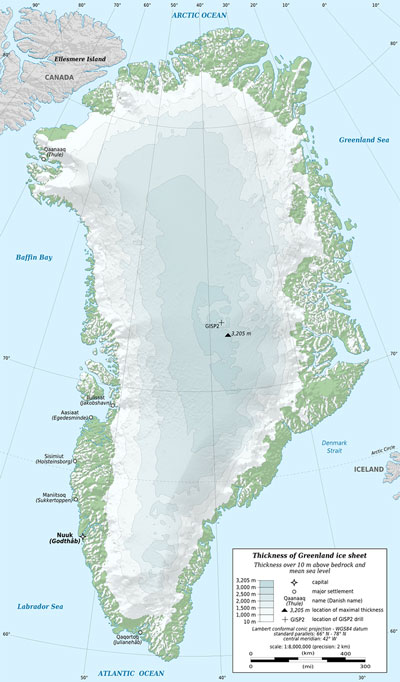
Seventy-nine percent of Greenland is covered by an icesheet averaging more than a mile deep and sometimes as much as two miles deep. This is sometimes abbreviated in scientific studies as the GIS.
The capital of Greenland is Nuuk with a population of over 20,000, over a third of the island’s population and the largest of five Greenland municipalities, all located on the southwest coast of Greenland. In 2020, 89.5 percent of the population were Greenlandic Inuits, related to Eskimos. About 7.5 percent were Danish and 1.1 percent were of other Scandinavian ancestry. The remaining 2 percent were mostly European, American, or Canadian. The official language is Greenlandic Inuit, but Danish and English are also spoken. Over 96 percent profess the Christian faith, which is specifically Lutheran for 95.5 percent. Due to Danish diligence in education, the population, both European and Inuit, are well educated.
Greenland is a self-governing autonomous territory of the Kingdom of Denmark. Citizens of Greenland are also citizens of Denmark. Greenland is part of NATO because it is part of Denmark. It therefore comes under NATO Article 5 protection if attacked. Although Greenland is not a member of the European Union (EU) and does not desire to be part of the EU because of EU fishing and seal-hunting regulations, it has cooperative agreements with the EU and receives sustaining development funds from the EU. Greenlanders have EU citizenship rights.
The Greenlandic government is a parliamentary system consisting primarily of the Greenland Inatsisartut, devolved from both the Danish Monarch and the Danish Parliament. The Greenland Inatsisartut has 31 members, including an influential Speaker. Greenlanders also have two representatives in the Danish Parliament. Executive authority is divided between the Prime Minister and the Danish High Commissioner.
Almost 93 percent of Greenland’s exports, which are 90 percent related to fish and seals—go to the EU, and 69 percent of imports come from the EU. Approximately 20 percent of Greenland’s GDP is funded by the Danish government. About half of Greenland’s government expenditures are funded by Denmark.
A Brief History of Greenland
The Thule people, the ancestors of the modern Inuit, were in Greenland on and off as far back as 2500 BC, but they did not immigrate in numbers from Arctic Canada until 1100 to 1200 AD, continuing to 1400 AD. Before the main Inuit migration to Greenland came Icelandic Vikings. in 986, Icelandic Vikings of mostly Norwegian origin began to settle in southwestern Greenland. To these are connected the names of Eric the Red and his son Leif Erikson. Leif Erikson is often credited with a brief stay in Vinland on the eastern coast of North America. Legend has it that the Norwegian King Olaf Tryggvason commissioned Leif to bring Christianity to Greenland, who accomplished it by 1000. About 650 Norse farms and other structures including several substantial chapels testify to their presence. The population of 3,000 to 6,000 souls, however had disappeared by about 1450, for reasons unknown but most likely unfavorable climate change. In 1262, Greenland was part of Kingdom of Norway. In 1721, it was part of the Dano-Norwegian Kingdom. In 1814, it was united to Denmark. Greenland’s tie to Denmark was severed by Nazi German occupation of Denmark in 1940. In 1941, the United States occupied Greenland to prevent invasion by Nazi Germany. In 1946, the U.S. offered to buy Greenland from Denmark for just over $1.6 billion in 2026 dollars. The Danes rejected the offer as incompatible with their best interests, history, and national identity.
In 1951, Denmark and the United States signed the Greenland Defense Agreement, which allowed the United States to keep its military bases in Greenland, and to establish new bases or "defense areas" if Denmark agreed, and if deemed necessary by NATO. The US military could freely use and move between these defense areas, but was not to infringe upon Danish sovereignty in Greenland.
In 1979, Greenland was given limited autonomy and their own parliament. Its present more autonomous status occurred in 2009, but it has retained strong connections to Denmark. The Danish armed forces as a coordinated part of NATO maintain immediate responsibility for Greenland’s Arctic security.
In 2023, Thule Air Base, built in 1943 on the northwestern coast of Greenland, changed its name to Pituffik Space Base. Only 150 personnel of the United States Space Force (USSF) established in 2019 are there. It is part of a global network of space surveillance and missile detection. It operates under a defense agreement between the U.S. and Denmark. The Base Commander there was relieved in April 2025 for a statement “undermining” U.S. acquisition of Greenland.
According to Douglas Macgregor, Daniel Davis, and other highly respected military analysts, there is no real threat to Greenland by China or Russia.
Moreover, any attempt to occupy Greenland given its severe arctic terrain, glaciers, and icebound seas is incompatible with military sanity. Approaching naval or ground forces could be easily annihilated.
As of 2025, Greenland had less than 100 miles of paved roads, and many of these are impassable much of the year. Even to get between the major five settlements, transportation has to be by air or dog sled, and even these are impacted by ice conditions. Even Greenland’s coastal flora consists of permafrost, low shrubs, and few trees.
Greenland is a very difficult place to extract natural resources for a number of reasons, including extreme weather conditions and a strong environmentalist community. The New York Times reported in March 2025 that despite dozens of exploratory projects, there are only two active mines. Danish economists and mining engineers believe mining will not have a significant place in Greenland’s economy for at least the next ten years. American investors are not lining up for a quick profit in Greenland.
Despite all the conjecture of rare earth minerals and valuable metals and energy sources, much of it is buried beneath anywhere from 25 feet to thousands of feet of shifting ice. Mining is a minimal part of Greenland’s GDP. Extraction costs for most known resources in Greenland are too overwhelming for profitably. Perhaps technology will eventually solve the problem—but how soon if ever.
Greenland is often portrayed as rich in rare-earth minerals, but experts argue this promise is largely illusory, as mining remains limited due to high costs, lack of infrastructure, and minimal local refining capacity. Although the island does contain resources, similar minerals are more abundant and accessible in other countries like the US, Brazil, Vietnam, and China, making Greenland a non-competitive option.
The bullying talk of forcibly taking Greenland because we want or need it reminds me of a Biblical passage about northern Israel’s King Ahab (874-853 BC). It is not a perfect analogy to the present situation or actors, but it has some moral relevance.
In 1 Kings 21, we learn that Ahab desired the vineyard of a faithful Jew, Naboth, which was near Ahab’s palace. Ahab offered to pay a fair price for it or give him a better vineyard. But Naboth replied, “The Lord forbid that I should give you the inheritance of my ancestors.”
Ahab’s crafty set of advisors, associated scoundrels, and false prophets managed to have Naboth falsely accused of treason and blasphemy and stoned to death by the crowd. So Ahab got the vineyard, but sorrows followed him, and a Syrian arrow ended his reign in 853 BC.
Wise kings must be careful in choosing advisers. Trusted advisers must have discerning wisdom, purposed integrity, and courageous honesty as well as loyalty.
Should the United States buy Greenland? Only if the price is acceptable—without any bullying or equivalent pressures—to both Greenland’s people and the Danish Parliament. Moreover, however favorable American politicians might view it, it must be an ethical exchange that also clearly profits the American people, American workers, families, and businesses within the realistically foreseeable future. Is there military value in buying Greenland? Perhaps, but this cannot outweigh all the other factors here. Perhaps, buying only a small portion of coastal northwestern Greenland around Pituffik at a generous price would suffice to meet President Trump’s security concerns.
“Might makes right” is a moral calculus unworthy of American traditions, common ethical standards around the world, and certainly Judeo-Christian values.
“…by setting forth the truth plainly we commend ourselves to every man’s conscience.”
—2 Corinthians 4:2.
 Mike Scruggs is the author of two books: The Un-Civil War: Shattering the Historical Myths; and Lessons from the Vietnam War: Truths the Media Never Told You, and over 600 articles on military history, national security, intelligent design, genealogical genetics, immigration, current political affairs, Islam, and the Middle East.