












Greenville County Auditor Scott Case spent a Back-to-Basics Breakfast walking residents through one of the most misunderstood subjects in local government: property taxes. From assessment ratios and millage rates to school tax credits and economic development incentives, Case's goal was to help taxpayers understand how every major component of their tax bill works.

Every year Greenville County property owners receive a tax bill in the mail. Most know how much they owe. Far fewer understand how that amount was calculated, who determined it, where the money goes, or why two similar homes can receive very different tax bills.
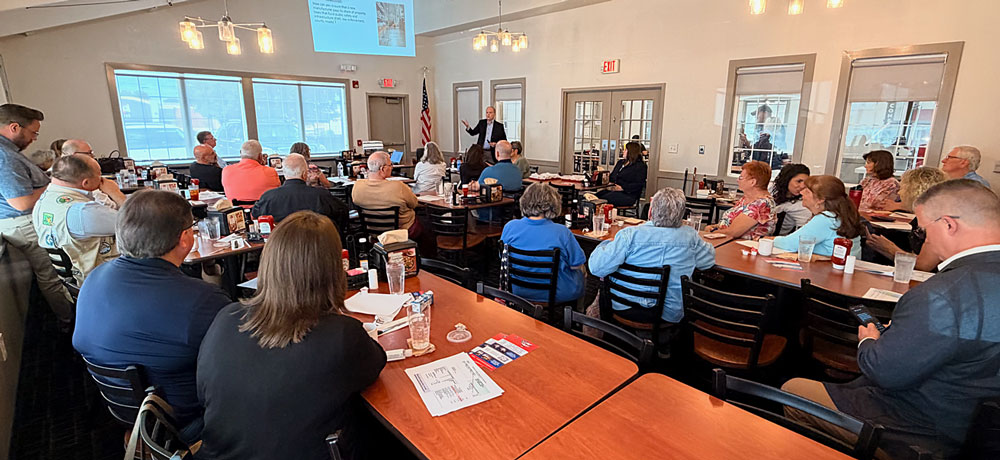
During a Palmetto Conservative Fund Back-to-Basics Breakfast on May 30 at Golden Corral, Greenville County Auditor Scott Case set out to answer those questions. Using sample tax bills, charts, and examples from Greenville County's tax system, Case walked attendees through the process from beginning to end.
Rather than focusing on political debates, the presentation focused on civic education. The goal was to help taxpayers understand how the system works and why certain numbers appear on their annual tax notice.
If there was a central theme throughout the morning, it was that understanding property taxes begins with understanding the tax bill itself.
Who Sends Your Tax Bill?
Case began by explaining that property taxation involves several different government offices, each with a distinct responsibility. The Greenville County Assessor determines property values. The Greenville County Auditor applies assessment ratios, exemptions, credits, and millage rates to calculate tax bills. The Greenville County Treasurer collects taxes and distributes the revenue to the various taxing authorities.
Meanwhile, much of the framework governing property taxation originates not at the county level but in the South Carolina General Assembly. According to Case, one of the most common misconceptions among taxpayers is assuming that Greenville County government controls every aspect of the tax system. In reality, state law determines many of the rules under which county officials operate.
Who Decides Your Tax Bill?
Many taxpayers assume Greenville County government sets property taxes. In reality, the final tax bill reflects decisions made by numerous governmental entities, including:
- South Carolina General Assembly
- Greenville County Council
- School districts
- Municipal governments
- Fire districts
- Libraries
- Technical colleges
- Special purpose districts
The Auditor's Office does not create tax policy. Instead, it applies the laws, exemptions, assessment ratios, credits, and millage rates established by state law and local taxing authorities.
The First Number on the Bill: Property Value
Every tax bill begins with a property value.
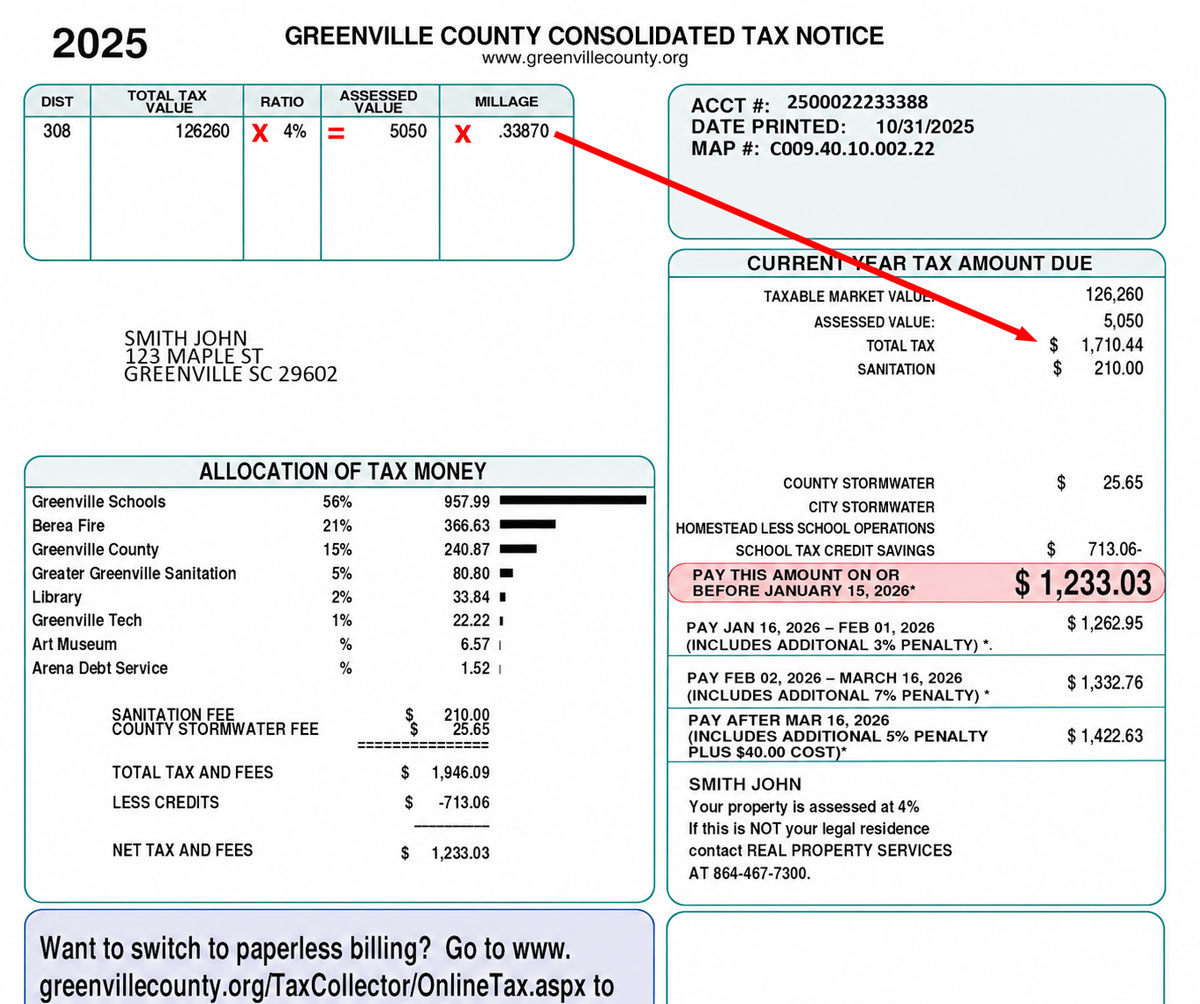
Using the sample tax notice above, Case pointed to the "Taxable Market Value" line, which showed a value of $126,260. That figure is established by the County Assessor's Office and represents the property’s market value used for taxation purposes.
If a taxpayer believes the market value assigned to their property is incorrect, they may begin an appeal process through the Greenville County Assessor's Office, which is responsible for determining property values. The Auditor's Office does not establish property values and therefore is not the office that handles valuation appeals.
Property values form the foundation upon which every other tax calculation is built.
The Formula Behind Every Tax Bill
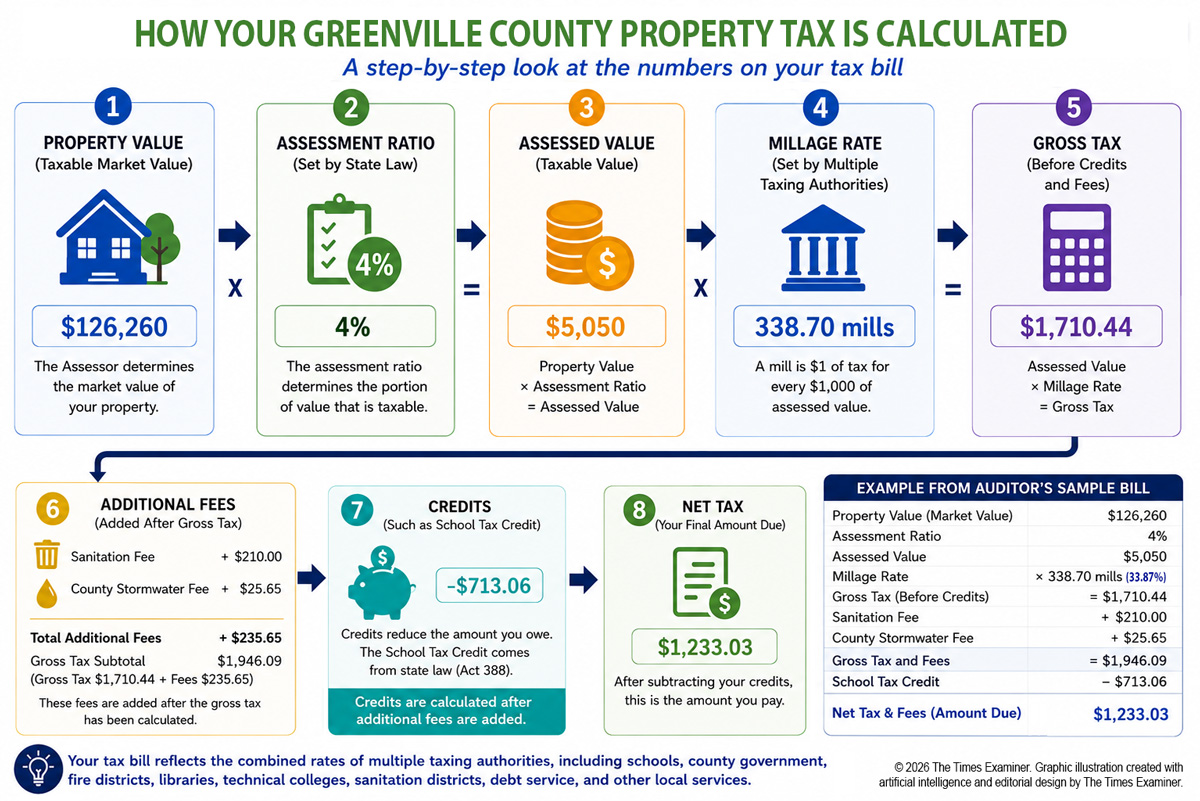
Case reduced the tax calculation process to a straightforward formula. Using the sample tax notice from Case's presentation, the calculation looked like this:
- Property Value ($126,260) × Assessment Ratio (4%) = Assessed Value ($5,050)
- Assessed Value ($5,050) × Millage (.33870) = Property Tax ($1,710.44)
Although the formula appears simple, confusion often arises because taxpayers may not understand assessment ratios or millage rates and how they apply.
What Is an Assessment Ratio?
Assessment ratios are established by state law and determine what portion of a property's market value becomes taxable. A primary residence receives a 4% assessment ratio under state law. If the owner does not live in the home and instead rents it to tenants, the property is generally assessed at 6%. Manufacturing property is assessed at 10.5%. Those ratios are set by state law, not by Greenville County or any local taxing districts.
South Carolina also provides additional property tax relief through the Homestead Exemption program. Homeowners who are at least 65 years old, legally blind, or permanently and totally disabled may qualify to exempt the first $50,000 of their primary residence's fair market value from certain property taxes. The exemption is established by state law and administered locally.
Because the ratio is applied before millage rates are calculated, assessment classifications have a major impact on the final tax bill. For owner-occupied homes, where the owner lives in the property as a primary residence, the 4% assessment ratio is one reason South Carolina homeowners often pay lower effective property taxes than they otherwise would under a higher assessment classification.
That distinction is important because taxpayers often assume all property tax decisions are made locally, when many of the rules governing assessments and classifications originate at the state level.

What Is a Mill?
Millage remains one of the least understood parts of the property tax system. Rather than being established by a single government body, the total millage rate reflects the combined rates imposed by multiple taxing authorities serving a property. Schools, county government, fire districts, libraries, technical colleges, sanitation districts, debt service obligations, and other entities each establish their own millage rates based on their budgetary needs. Those individual rates are then combined to create the total millage rate that appears on a taxpayer's bill.
Each mill of the total 338.70 mills shown on the sample bill represents one dollar of tax for every $1,000 of assessed value. In practical terms, the combined millage rate is simply the tax rate applied to a property's assessed value, much like a sales tax rate is applied to a purchase.
Think of a millage rate as a property tax rate expressed in a different format. The sample bill used in Case's presentation showed a combined rate of 338.70 mills. That means the property owner pays $338.70 in tax for every $1,000 of assessed value. To calculate the tax, the millage rate is divided by 1,000 and then multiplied by the property's assessed value.
For many taxpayers, 338.70 mills appears to be some mysterious government number. In reality, it is simply a tax rate expressed in mills rather than percentages. Dividing 338.70 by 1,000 converts it to 0.33870, or 33.87%. That rate is applied to the property's assessed value of $5,050, not its market value of $126,260. The distinction is important because property taxes are not calculated on a home's full market value. They are calculated on the assessed value after the state's assessment ratio has already been applied.
As a result, taxpayers often see only one bill in the mailbox rather than separate bills from every taxing authority. Yet that single payment helps fund numerous governmental services throughout the community.
Where Does the Money Go?
For many attendees, this portion of the presentation was eye-opening because it challenged a common assumption that most property tax revenue goes directly to county government. Using the sample tax bill, Case showed how the money was distributed.
The following percentages are not determined arbitrarily. They reflect the share of the total millage rate established by each taxing authority. Entities that levy more mills receive a larger portion of the property tax collected, while those that levy fewer mills receive a smaller share.
- Greenville Schools received approximately 56% of the property tax collected.
- Berea Fire received 21%.
- Greenville County received 15%.
- Greater Greenville Sanitation received 5%.
- The Library received 2%.
- Greenville Technical College received 1%.
- Smaller percentages went toward the Art Museum and Arena Debt Service.
The distribution illustrated a point Case emphasized repeatedly. While taxpayers often view the bill as a county tax bill, much of the money is directed to entities other than county government itself.
Why Your Neighbor Pays Something Different
The district number on a tax bill, as seen in the tax notice sample above, often receives little attention, but Case explained that it plays an important role.
Different tax districts may include different combinations of school districts, fire districts, municipalities, and special purpose districts. As a result, two homes with similar market values may have significantly different tax bills.
A property located within one fire district may pay a different rate than a property located only a short distance away. Different municipalities may also impose different millage rates. These geographic differences help explain why comparisons between neighbors are not always straightforward.
The School Tax Credit Explained
The sample tax bill used in the presentation showed a School Tax Credit Savings of $713.06. Case explained that this credit stems from Act 388, legislation enacted by the South Carolina General Assembly in 2007.
Under the law, owner-occupied homes (that is, the owner lives in the home) do not pay school operating taxes. The school districts still receive funding, but the revenue is replaced through statewide sales tax collections rather than property taxes on owner-occupied residences.
Without the credit shown on the bill, the homeowner's tax obligation would be substantially higher. The example presented during the breakfast showed total taxes and fees of $1,946.09 before credits. After applying the school tax credit, the final amount due was reduced to $1,233.03.
For many taxpayers, understanding the school tax credit answers one of the largest questions on the annual bill. Yet Case noted that another source of confusion often follows close behind: reassessment.
Many homeowners see property values increase and assume local governments automatically receive more tax revenue. According to Case, that assumption overlooks one of the most important safeguards built into South Carolina's property tax system.
What Happens During Reassessment?
Few topics generate more anxiety among property owners than reassessment notices.
Greenville County conducts a countywide reassessment every five years as required by South Carolina law. The most recent reassessment took effect in 2025 and updated property values to reflect changes in the real estate market since the previous reassessment cycle.
Case explained that many taxpayers assume a higher property value automatically means local government will collect significantly more tax revenue. South Carolina's reassessment system was designed, at least in part, to prevent that outcome.
Under state law, when a county undergoes reassessment and property values increase, taxing authorities generally must reduce their millage rates through what is commonly called a rollback. The purpose is to help prevent governments from receiving an automatic revenue windfall simply because property values have increased.
That does not mean every property owner experiences the same result.
Some properties appreciate faster than others. A home that increases in value substantially more than the county average may still experience a larger tax impact even after rollback millage is applied. Likewise, properties that increase less than average may see little change.
Case stressed that reassessment is intended to update property values to reflect market conditions. The process is separate from decisions made later by taxing authorities regarding budgets and millage increases. Understanding that distinction helps explain why rising property values do not always translate directly into equivalent increases in tax bills.
As Case noted during the presentation, taxpayers often hear discussions about reassessment and millage increases as though they are the same thing. In reality, they are separate parts of the process that occur at different stages.
Understanding Rollback Millage
One of the most misunderstood safeguards in South Carolina's property tax system is rollback millage.
Case explained that when a county completes a reassessment and property values increase, taxing authorities generally cannot simply keep the same millage rate and collect a windfall of additional revenue. Instead, state law requires most taxing authorities to reduce, or "roll back," their millage rates to account for the increase in assessed value.
The purpose of rollback is straightforward. Reassessment is intended to update property values to reflect current market conditions, not automatically increase tax collections. Without rollback requirements, rising property values across an entire county could result in significant revenue increases even if governments made no changes to their budgets.
In simple terms, rollback attempts to keep revenue relatively neutral after a countywide reassessment. If the total taxable value of property rises, the millage rate is generally reduced so that taxing authorities collect approximately the same amount of revenue they received before reassessment, subject to limits and exceptions established by state law.
That does not mean every taxpayer receives the same result within a taxing district. Rollback is applied to the taxing authority's entire tax base, not to individual properties. As a result, all properties within the district generally receive the same rolled-back millage rate, but not all properties experience the same change in taxes because some properties increase in value more than others during reassessment.
For example, two homes in the same taxing district may receive the same rollback millage rate after reassessment. If one home's value increased substantially more than the district average while the other increased less than average, the higher-appreciating property may still see a larger tax bill. The reason is simple: the same tax rate is being applied to different assessed values.
Rollback adjusts the overall tax rate for the jurisdiction, but an individual tax bill still depends on how a property's value changed relative to other properties in the district.
Case emphasized that reassessment and taxation are separate steps in the process. Reassessment determines a property's value. Rollback adjusts the millage rate to account for countywide changes in value. Taxing authorities then make separate budget decisions that may increase or decrease taxes beyond the rollback calculation.
Understanding those distinctions helps explain why a reassessment notice does not automatically predict what a taxpayer's final bill will be and why discussions about property values and tax increases are often related but not identical.
With reassessment and rollback explained, Case shifted the discussion from residential property owners to another group heavily affected by South Carolina's property tax system: businesses.
The same basic formula used to calculate a homeowner's tax bill also applies to commercial and manufacturing property. The difference is that those properties operate under very different assessment ratios, creating dramatically different tax obligations and setting the stage for one of the most debated topics in local government: economic development incentives.
Why Businesses Pay Different Tax Rates
Once attendees understood how residential taxes are calculated, Case shifted to a question that frequently arises during economic development discussions. Why do businesses appear to be taxed differently than homeowners?
The answer begins with assessment ratios established under South Carolina law.
Using a Greenville County example, Case compared a residential property, commercial property, and manufacturing facility with the same taxable value of $350,000.
- The residential property, assessed at 4%, generated approximately $2,430 in taxes.
- The commercial property, assessed at 6%, generated approximately $6,930.
- The manufacturing property, assessed at 10.5%, generated approximately $12,130.
The comparison illustrated the dramatically different tax burdens placed on various classifications of property before any economic development incentives are considered.
Case argued that many residents are surprised to learn that South Carolina's manufacturing property tax structure has historically ranked among the highest in the nation. While homeowners often benefit from low assessment ratios and credits, manufacturers face a much different calculation.
This difference, he explained, became one of the primary reasons state lawmakers and local governments began exploring tools designed to make South Carolina more competitive when recruiting industrial investment. The discussion served as a bridge between the mechanics of property taxation and the economic development policies that have shaped Greenville County's growth over the past several decades.
What Is a FILOT and How Does It Work?
Having shown the disparity between residential and manufacturing tax rates, Case arrived at one of the most frequently debated subjects in local government: FILOT agreements.
His argument was straightforward. If South Carolina taxes manufacturing property at substantially higher rates than neighboring states, local governments must decide whether they are willing to use available tools to remain competitive for jobs and investment.
One of those tools is a FILOT, short for Fee In Lieu Of Taxes.
At this point, a taxpayer might reasonably ask a simple question: If the 10.5% manufacturing assessment ratio is established by state law via its Constitution, how can a county legally reduce it?
According to Case, the answer is that FILOT agreements are themselves authorized under South Carolina law. Rather than changing the constitutional assessment ratio, state law allows qualifying economic development projects to enter into Fee In Lieu Of Taxes agreements that provide an alternative tax structure under specific conditions established by the General Assembly.
Case noted that changing the 10.5% manufacturing assessment ratio itself would be far more difficult. Because the assessment ratio is established in the South Carolina Constitution, changing it would require a constitutional amendment. That process begins with approval by the General Assembly and ultimately requires approval by South Carolina voters in a statewide referendum.
Until such a change occurs, FILOT agreements remain one of the primary tools available to address the disparity between South Carolina's manufacturing assessment ratio and those found in many competing states.
A FILOT does not involve a government writing a check to a company. Instead, it allows a qualifying business to pay a negotiated fee rather than the standard property tax rate that would otherwise apply under state law, provided certain requirements are met.
Case described FILOTs as local property tax incentives rather than state grant programs. Under the system, a company agrees to meet specific investment and, in many cases, employment commitments. In exchange, the company receives a reduced assessment ratio for a defined period of time.
Using another example from the presentation, Case showed how a manufacturing facility taxed at the standard 10.5% assessment ratio could face an annual property tax burden of approximately $12,130 on a $350,000 property.
A typical FILOT could reduce that burden to approximately $6,930. Certain enhanced agreements could reduce the effective burden even further. Case emphasized that these agreements are not negotiated in secret and are not automatically granted.
According to the presentation, every agreement must:
- Comply with South Carolina law.
- Meet Greenville County's established economic development guidelines.
- Be approved by County Council.
- Be publicly disclosed before final approval.
The presentation also addressed a common criticism that companies receive incentives and then fail to fulfill their promises. Case explained that FILOT agreements include monitoring and enforcement provisions.
The South Carolina Department of Revenue audits compliance with state law requirements, while the Greenville County Auditor's Office monitors local contractual obligations. If a company fails to meet required commitments, it can lose the benefits of the agreement, be returned to the standard tax structure, and in some circumstances be required to repay taxes that would have been owed absent the FILOT agreement.
Case's broader argument was that FILOTs should be viewed not as gifts from government but as negotiated agreements intended to attract investment while requiring measurable performance from participating companies.
Why Greenville Pursues Economic Development
Case concluded the presentation by stepping back from tax calculations and addressing a larger question.
Why do local governments devote so much attention to economic development?
Using population, employment, and workforce data, Case argued that Greenville County's continued growth requires a steady supply of new jobs.
Case also referenced the Greenville Area Development Corporation (GADC), the county’s economic development organization, which works with local and state officials to recruit investment and jobs to the region. While County Council ultimately approves FILOT agreements and other economic development incentives, organizations such as the GADC often assist in evaluating projects, coordinating recruitment efforts, and providing information to decision-makers. Case noted that he helped establish the organization during his time on County Council.
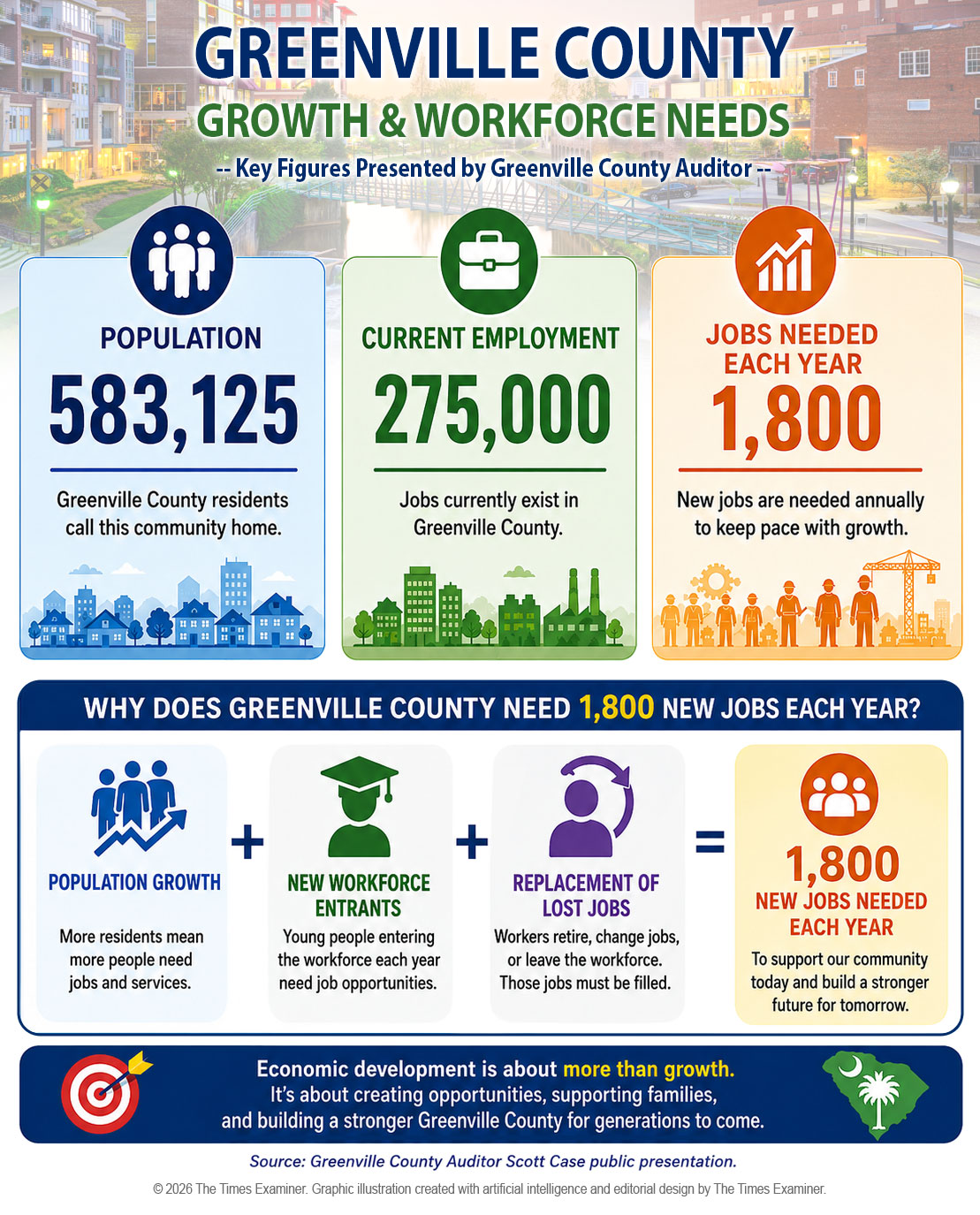
According to figures presented at the breakfast, Greenville County's population has grown to approximately 583,125 residents while supporting roughly 275,000 jobs. Case estimated that maintaining the county's current standard of living requires approximately 1,800 new jobs each year. See the illustrated image below.
In simplified terms, the estimate reflects a combination of population growth, new workforce entrants, and the need to replace jobs lost through layoffs, retirements, business closures, and other economic changes:
New Jobs Needed = Population Growth + Workforce Entrants + Replacement of Lost Jobs
That figure reflects several factors. The county must create jobs for young people entering the workforce. It must replace jobs lost through business closures, layoffs, and industry shifts. It must also provide opportunities for a growing population.
Case cited recent workforce data and Workers Adjustment and Retraining Notification (WARN) reports showing hundreds of jobs lost annually through layoffs and plant closures. At the same time, economic development recruitment efforts have generated new employment opportunities that partially offset those losses.
Without economic development recruitment, many of Greenville County's largest employers and supplier networks might not exist in their current form. Case pointed to companies associated with the automotive industry, including Michelin, BMW suppliers, and other manufacturing operations that have become major contributors to the local economy.
Whether residents support or oppose specific incentive programs, Case argued that understanding the county's employment needs provides important context for discussions about economic development policy.
The goal of the presentation was not to persuade attendees to support any particular project. Rather, it was to explain the reasoning that policymakers often cite when evaluating economic development proposals and tax incentive agreements.
More Than a Tax Bill
As the breakfast came to a close, the discussion had traveled from a small district number printed in the corner of a tax bill to some of the largest questions facing Greenville County's future.
Along the way, attendees learned how property values are determined, why assessment ratios matter, where millage rates originate, how school tax credits work, and why economic development incentives became part of South Carolina's tax system.
Yet the central lesson of that morning was remarkably simple. Most taxpayers focus on the amount due at the bottom of the bill. Case encouraged them to understand the numbers above it.
Because behind every property tax bill is a series of decisions involving state law, local government, schools, public services, and economic development. Understanding those decisions, he argued, is the first step toward becoming a more informed taxpayer and a more engaged citizen.
For many attendees, the biggest takeaway was not whether taxes were too high or too low. It was finally understanding how the system works. After all, a tax bill is more than a demand for payment. It is a map of how government works for those willing to read it. And if citizens want to change their government, they must first understand it.