












How Scripture described the boundary between light and darkness long before modern astronomy gave it a name

For centuries, critics have claimed that the Bible reflects an ancient and primitive understanding of the universe and of science in general, assuming that modern science must correct what Scripture once misunderstood.
But what if that assumption is backwards?
The Bible and an Overlooked Astronomical Reality
Long before telescopes, satellites, or space travel, the Bible described a physical reality that modern astronomy would not formally explain or name until thousands of years later. One of the clearest examples is an ancient phenomenon that astronomers today call “the terminator.” No, I am not talking about Hollywood, futuristic machines, or even Arnold Schwarzenegger himself. I am referring to the real, observable boundary between light and darkness.
But before we get into the details, let us start by reading Genesis 1:1-5:
“(1) In the beginning God created the heaven and the earth. (2) And the earth was without form, and void; and darkness was upon the face of the deep. And the Spirit of God moved upon the face of the waters. (3) And God said, Let there be light: and there was light. (4) And God saw the light, that it was good: and God DIVIDED the light from the darkness. (5) And God called the light Day, and the darkness he called Night. And the evening and the morning were the first day.”
Take notice of a key phrase in verse 4, “God divided the light from the darkness.” It’s interesting that God placed emphasis on this simple act, the act of separating the light that He had just created from the darkness that had already existed. In other words, God created a rule that light and darkness cannot occupy the same space at the same time, as they are experienced and observed by the human eye.
Why Light and Darkness Cannot Coexist

Consider this simple example illustrated in the above image. Enter a dark room and turn on the light, and darkness immediately gives way. The wall separating that room from the one next door confines the light, leaving the adjoining room dark. Remove the wall between the two rooms, and the light instantly spreads into the other room’s space beyond where the wall existed.
We clearly see that light and darkness cannot coexist in the same space. The moment light is introduced, darkness gives way instantly because light travels at the extraordinary speed of 186,282 miles per second (299,792 kilometers per second). What we experience as an immediate change is simply the result of light reaching every visible surface at once. Either a room is pitch dark, or some measure of visible light penetrates the darkness.
But despite their inability to coexist, did you know that both light and darkness can meet at an edge without an object, such as a wall, separating them? To the naked eye, they can appear to actually touch.
This is where our subject comes into play: the Terminator.
What Science Calls the Terminator
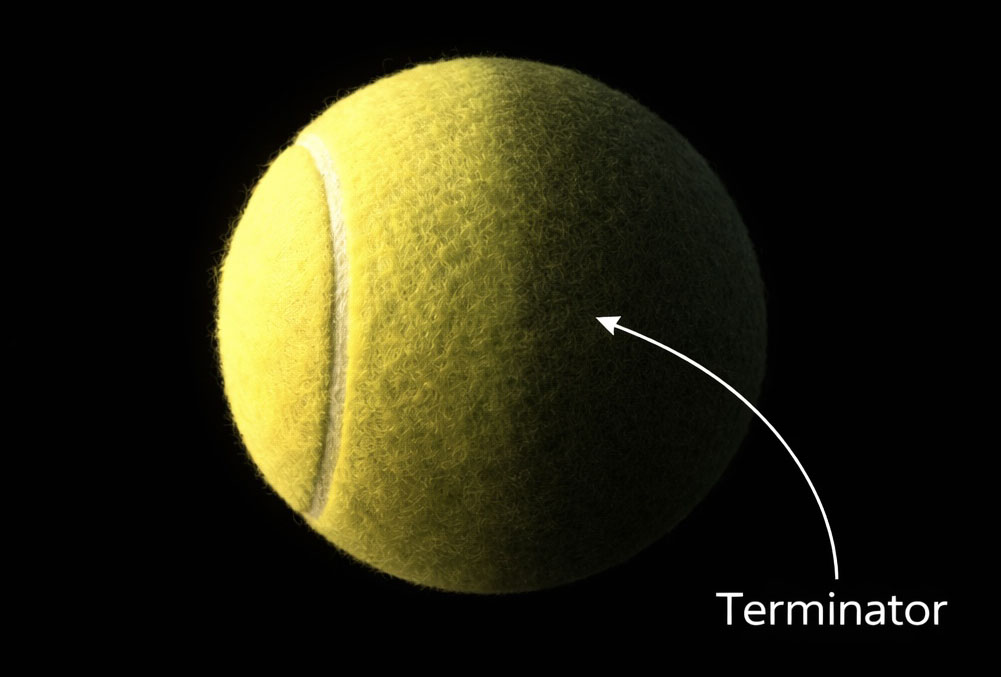
So, what is this Terminator? Science defines it as the visible boundary between the illuminated and dark sides of a spherical object, such as the tennis ball in our image or any object with a curved, three-dimensional surface. That dividing line marks the point where light begins, and darkness ends, where light effectively terminates darkness as the two appear to meet on the surface.
Why Flat Surfaces Cannot Produce a Terminator
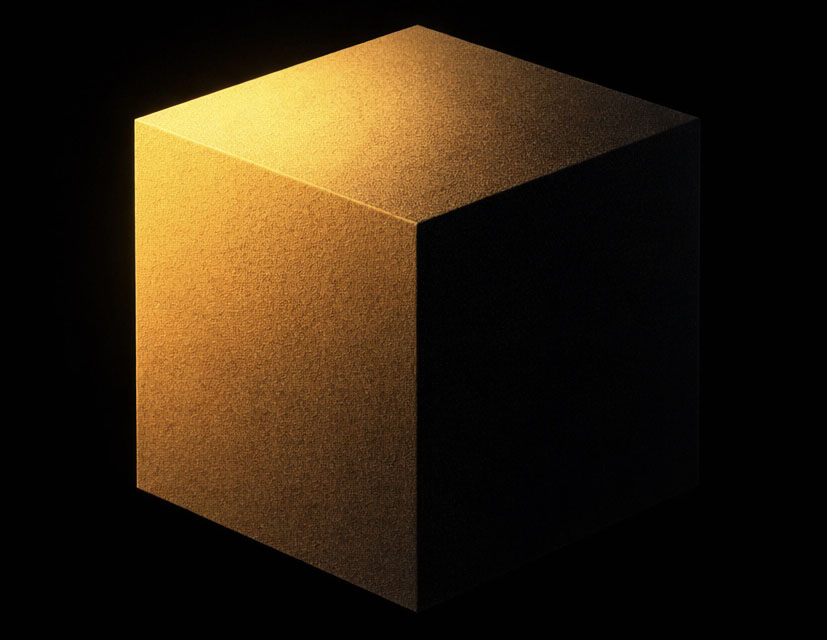
As a simple illustration of physics, consider the shape of a square, as shown in the image. A square has no terminator because its corner edges divide the lighted sides from the dark sides, much like the wall in our earlier example. Yes, it appears divided, and total separation still exists.
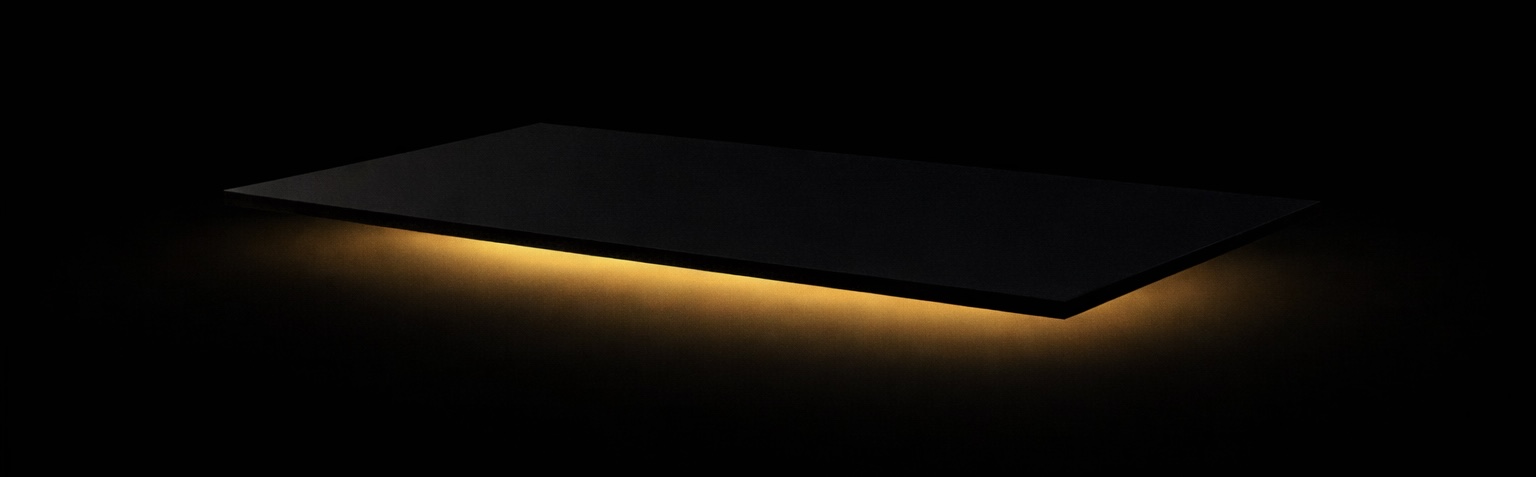
But what about a flat surface like the flat-earthers believe? It can never have a terminator because it does not possess curvature, as a globular object does, such as our tennis ball. There is no way for a gradual boundary between light and darkness to exist, because once light passes below the edge of a flat surface, the visible light is immediately absent above it.
The flat surface itself becomes the sharp dividing plane between light and darkness, much like the floor of a room. The room above the floor is lit, while the room beneath it remains dark.
The Terminator Written Across the Heavens
How does this apply to astronomy and demonstrate that the Earth is round rather than flat? We return to Genesis 1:4, where God divided the light from the darkness and called the light Day and the darkness Night. That descriptive narrative aligns naturally with a round, three-dimensional Earth on which a terminator exists, with daylight and darkness appearing to meet. It describes a world in which light begins, and darkness ends, where light terminates darkness, as it does on every planet and moon in our solar system, wherever sunlight reaches.
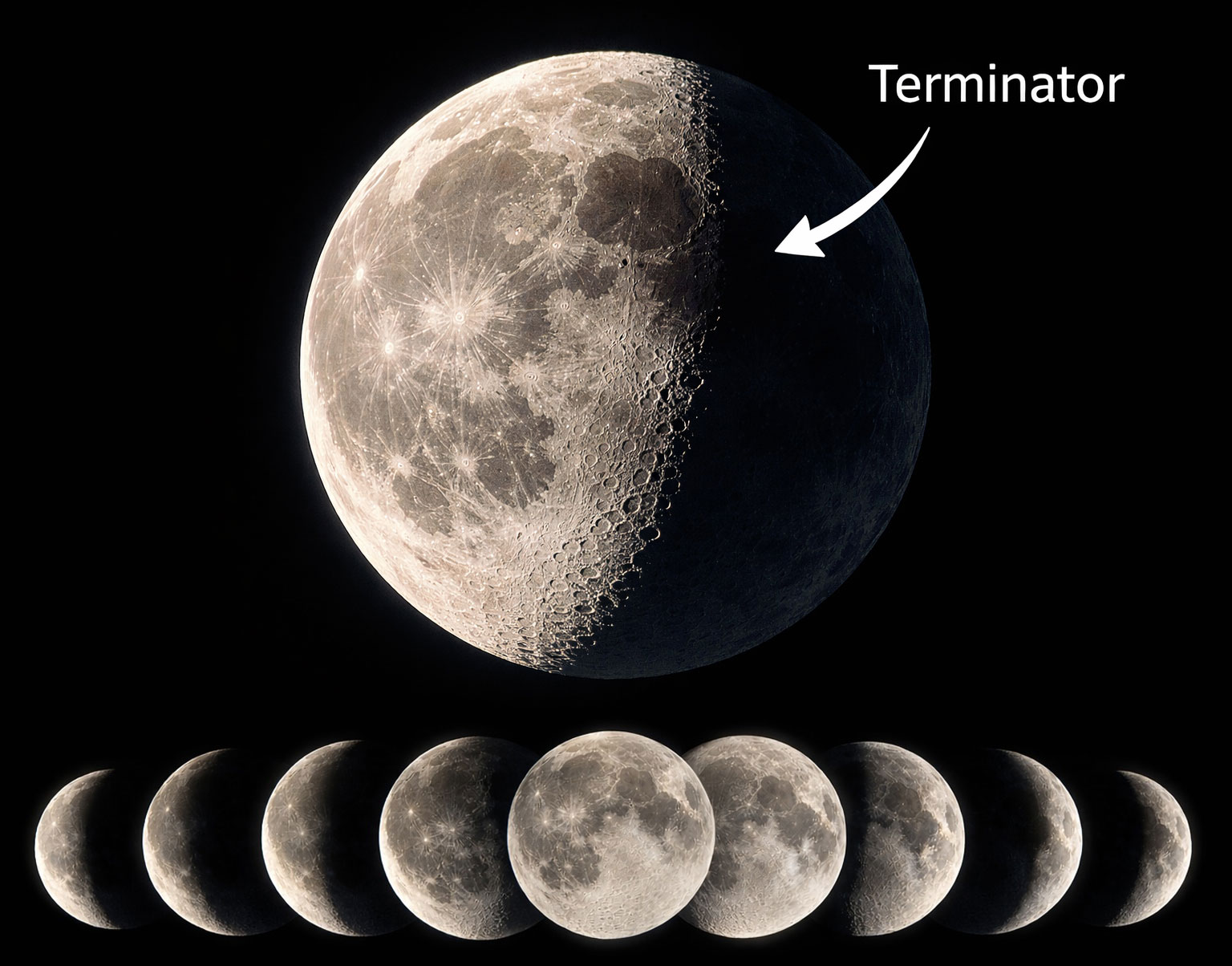
The phases of our planet’s Moon provide a clear example of where we can observe, with our own eyes, this concept of the terminator, the visible boundary where sunlight and the darkness of space meet. As this terminator moves across the lunar surface over the course of a month, it becomes evident that the Moon is a globe. From our viewpoint on Earth, the consistent movement and ever-changing curvature of the terminator across the Moon during its phases unmistakably reveal that the Moon is a round object.
Secular historians and scientists often report that, in earlier periods, many people believed the Earth was flat rather than round. Today, it is widely accepted that the Earth is spherical. Although this understanding is now considered settled science, a small number of individuals who believe the Earth is flat, commonly referred to as flat-earthers, still exist. They continue to attract an unmistakable following to this day.
Everyday Observation Tells a Different Story
While a relative is speaking with family on the other side of the world, they can experience the transition between day and night in real time. As the sun sets here, it is rising there. Over the course of the same call, whether by voice or FaceTime video, both observers on opposite sides of the planet can visually witness daylight leaving one side of the Earth while arriving on the other. This continuous movement of light and darkness across the planet is incompatible with a flat surface and is exactly what we illustrated earlier.
Daniel 12:4 states that in the last days “many shall run to and fro, and knowledge shall be increased.” In other words, Daniel foresaw a time when human beings would travel rapidly across great distances and gain a deeper understanding of the world around them.
Today, we humans move to and fro across the Earth in ways earlier generations could not. When traveling by airplane across the globe to the other side of the world, the traveler remains continuously above the Earth’s surface, watching it pass beneath them without interruption. There is no sudden edge, no drop-off, and no break in the surface as we travel from one side of the world to the other. This constant presence of the surface beneath us as we travel around the planet only makes sense if the Earth is curved.
When these two observations are considered together, continuous travel above an unbroken surface and the simultaneous experience of daylight in one location while darkness exists elsewhere on that same uninterrupted surface, they describe a three-dimensional world. The Earth must be round, because only a curved surface allows us to travel endlessly across it while light and darkness shift from one side to the other at the same time.
A Moving Boundary on a Rotating World
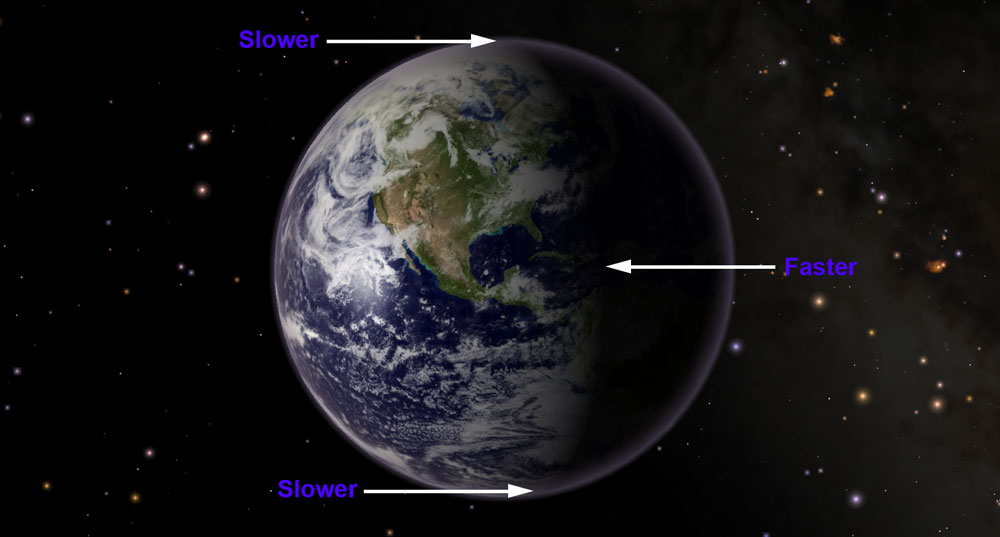
This boundary between light and darkness is not fixed. As the Earth rotates, the terminator is constantly moving across the planet’s surface. At the equator, it travels at roughly 1,040 miles per hour (463 m/s). Near the North and South Poles, however, the same boundary moves dramatically more slowly due to the Earth’s curvature. At very high latitudes and during certain times of the year, its motion can be slow enough that a person could remain in twilight by walking with it. Depending on the season, the terminator’s movement near the poles can be so gradual that, to an observer, it progresses at a pace comparable to the motion of the hour hand on a clock. This variation in speed across the Earth’s surface is a direct consequence of curvature and rotation. It is Geometry 101 and provides observable, scientific evidence that the Earth is round.
In earlier centuries, the occasional observer lacked the ability to move fast enough or far enough to observe the shifting boundary between day and night across Earth’s surface, nor could they experience phenomena such as jet lag that reveal the planet’s rotation firsthand. They lacked instant communication to compare daylight and darkness with those on the opposite side of the world, and they had no satellites transmitting images or video of the Earth from space. For most of human history, the only celestial body available for such terminal observation was the Moon.
When Science Put a Name to What Was Already Known
When did humanity as a whole begin to understand that the Earth is round? Secular historians often credit ancient Greek philosophers with formalizing this conclusion.
NASA’s educational Question and Answer resource for children, known as Starchild, addresses this question directly in response to a child’s inquiry, “Who figured out the Earth was round?” NASA explains that the Earth’s spherical shape had been recognized since the time of the ancient Greeks. According to NASA, Pythagoras proposed a round Earth around 500 B.C., based in part on observations of the Moon’s changing phases and the curved boundary between light and darkness. Around 350 B.C., Aristotle further affirmed the Earth’s spherical nature through stellar observations made while traveling north and south. https://starchild.gsfc.nasa.gov/docs/StarChild/questions/question54.html
While historians and scientists often credit secular thinkers who lived centuries before Christ with recognizing the Earth’s shape, Scripture had already described this reality long before. In this sense, modern science did not overturn the biblical record. It eventually caught up to what Scripture had already described.
Scripture’s Language of Curvature and Boundary
Isaiah 40:21-22, written around 700 B.C., approximately 200 years before Pythagoras, states, “It is he that sitteth upon the CIRCLE of the earth.” The Hebrew word translated as “circle” is chug, a term denoting something drawn or inscribed with curvature rather than a flat disk.
Let us go even further back in antiquity to find our key passage in the Book of Job. Most theologians place Job in the patriarchal period, around 2000 B.C., roughly 1,500 years before Pythagoras. In Job 26:10, our theme verse reads, “He hath compassed the waters with bounds, until the day and night come to an end.”
The English word translated as “compassed” comes from the Hebrew ḥāqaq, meaning “to engrave, inscribe, or mark out a boundary.” It conveys the idea of something being deliberately drawn or established with deliberate precision. The Earth’s surface is composed of more than seventy percent water, and Job describes a boundary traced across those waters where day and night come to an end, or, using our established term, where light terminates darkness.
Other translations express this same idea with similar clarity. One reads, “He marks out the horizon on the face of the waters as a boundary between light and darkness.” Another states, “He has inscribed a circle on the face of the waters at the boundary between light and darkness.”
Job is describing the same visible boundary we now call the terminator. This description cannot be referring to the Moon, which, though a globular object with its own terminator, contains no surface water. The passage instead aligns precisely with the rotating Earth and the boundary between light and darkness drawn across its waters, where sunsets and sunrises are experienced.
A Boundary Inscribed by Light Itself
In a very real sense, the terminator is drawn by light itself. As the Earth turns, light does not suddenly switch on or off; rather, it continuously and gradually reaches and then leaves the surface. To an off-planet observer, this creates the impression of a line being traced across the world, as though light were gently sketching its boundary as it moves. Scripture describes this same Earth as an object that “hangeth upon nothing” (Job 26:7), a globular world suspended in space, upon which this moving boundary between light and darkness is continuously drawn.
What we are witnessing is light actively marking the surface through motion over time. When observed continuously, motion leaves a visible path in human perception. What Job verbally describes as a boundary being compassed or inscribed reflects how this moving edge of light would naturally appear to the eye, not as a single moment, but as a line continually drawn across the face of the waters.
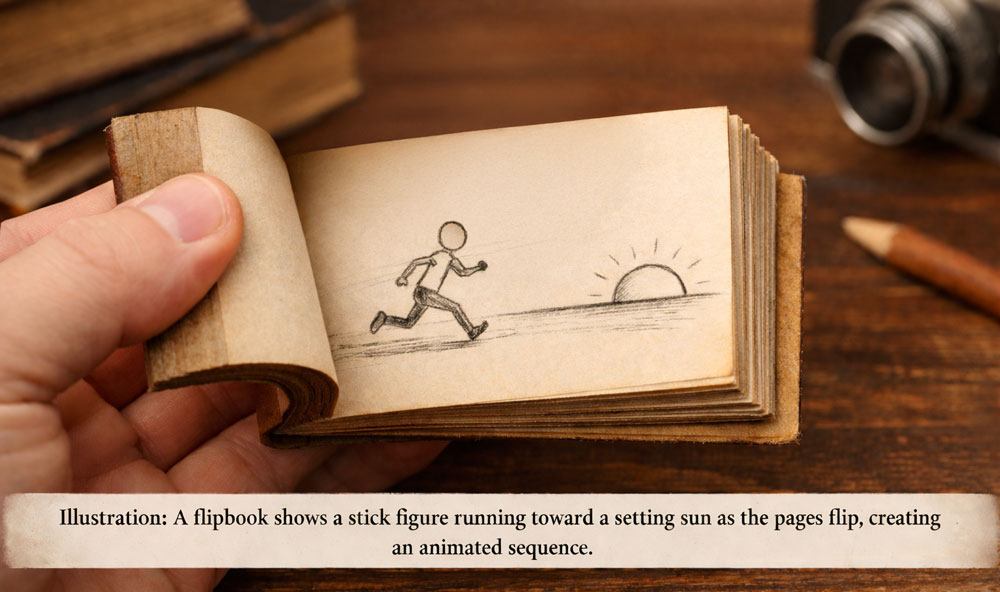
This effect can be illustrated much like an old flip-book animation. Each individual image is a static sketch in itself, but when viewed in rapid succession, the eye perceives smooth, continuous motion. In the same way, as the Earth rotates, the boundary between light and darkness is progressively traced across the surface in our perception, moment by moment, forming the very line Job described.
This same effect can be seen even more clearly on the Moon, almost as if God the Creator provided a visible clue. With no atmosphere to scatter light, the boundary between light and darkness appears sharply defined as it moves across the lunar surface. On Earth, however, the presence of an atmosphere diffuses light, softening the terminator’s appearance without changing its underlying form. Diffusion affects how the boundary looks, not the geometry that creates it.
No Shadow of Turning
James 1:17 offers a subtle but striking description, stating that with God there is “no variableness, neither shadow of turning.” A shadow produced by turning is precisely what a rotating, three-dimensional Earth creates when exposed to a fixed source of light, the Sun. As the planet turns, the boundary between light and darkness shifts across its surface, forming the shadow line we observe as the terminator.
The phrase used by James, “with God,” is central to this description. God is not presented as something that turns with a terminator, wanders, or shifts position, as a planet does, but as the unchanging source of light itself, where no terminator exists on its surface, much like we observe with the Sun as a fixed source of illumination. Just as a fixed, fully illuminated star reveals the turning of a planet by the shadows it casts, Scripture presents God as constant and immovable, while creation moves in relation to Him as the true light source. The shadow is not found in the light, but in the turning of the illuminated, globular object under that light.
How Job Could Describe What He Could Not See
This brings us to an important question. How did Job, living thousands of years before modern science, describe this astronomical reality with such precision? He could not observe this effect across Earth in the way we can today using satellites and space-based imagery. To see the full boundary between light and darkness on the planet requires a vantage point beyond the Earth’s surface, something no ancient observer could attain.
Scripture itself addresses that question. Second Peter 1:21 explains that “holy men of God spake as they were moved by the Holy Ghost.” The same Spirit who moved upon the face of the waters at creation in Genesis 1 also moved upon Job as an author, guiding his words as he described a boundary he could not directly observe on the Earth itself, yet could perceive through the Moon, which God appears to have provided as a visible illustration of that same reality.
Light, Darkness, and the God Who Governs Them
Throughout Scripture, light and darkness are not treated as abstract ideas, but as ordered realities governed by a Creator who does not change. What we observe in creation, the steady turning of the Earth, the moving boundary between day and night, and the consistent behavior of light itself, reflects that order. Long before modern science named these phenomena, Scripture described a world shaped by intention rather than chance, where light and darkness follow paths set by God. Isaiah brings this theme together by reminding us that the same God who governs creation also reveals Himself through it.
This same pattern also carries spiritual significance. Just as light and darkness exist within creation without ever escaping God’s authority, so the realities of good and evil unfold within a world that remains fully seen and governed by Him. Darkness may prevail for a moment, but on every turning planet, it will not remain so. Darkness does not hide from the presence of the great Illuminator, nor does the existence of evil imply the absence of divine control. Scripture consistently presents God as One who allows both light and darkness to exist within His ordered creation, while never surrendering sovereignty over either. In this way, the physical boundary between light and darkness serves as a reminder that nothing in creation, whether bright or shadowed, is ever beyond God’s sight or purpose.
Truly, the Bible is God’s inspired and living Word. The Author of creation is the same Author of Scripture, and when rightly understood, true scientific observation does not stand in opposition to it, but stands in agreement with it.
------------------------
Isaiah 45:5-8: “I am the LORD, and there is none else, there is no God beside me: I girded thee, though thou hast not known me: That they may know from the rising of the sun, and from the west, that there is none beside me. I am the LORD, and there is none else. I form the light, and create darkness: I make peace, and create evil: I the LORD do all these things. Drop down, ye heavens, from above, and let the skies pour down righteousness: let the earth open, and let them bring forth salvation, and let righteousness spring up together; I the LORD have created it.”