












Attorney General candidate discusses trafficking, immigration enforcement, and prosecutorial strategy during Greenville forum
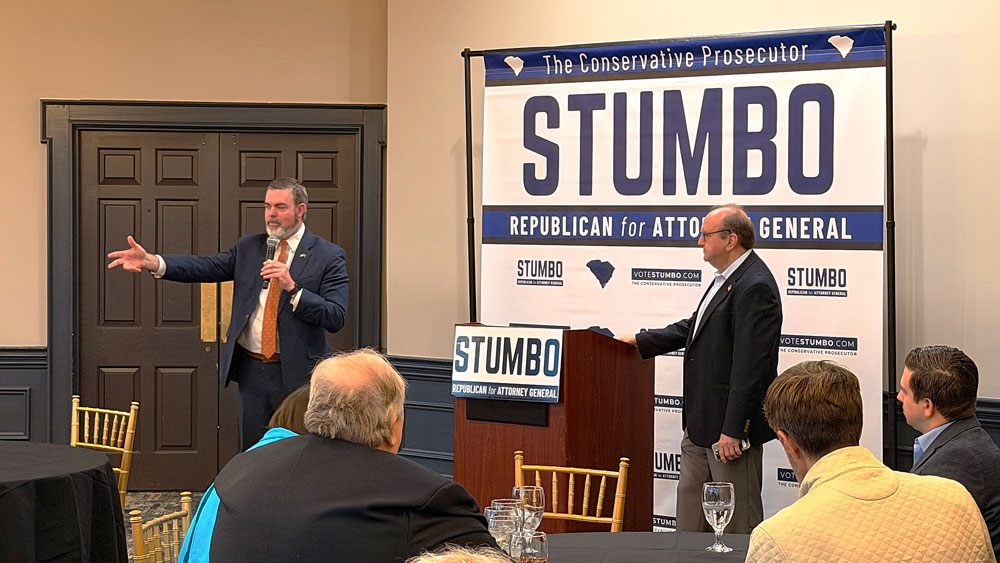
GREENVILLE, SC – Republican Attorney General candidate David Stumbo delivered an extensive and detailed policy discussion during an event titled ‘An Evening with Solicitor Stumbo’ hosted by the 4th Congressional District Republican Club, offering a wide-ranging look at his approach to law enforcement, drug policy, judicial reform, and state governance.
The event, organized by club president Nate Leupp and moderated by talk radio host Joey Hudson, included both prepared remarks and an extended question-and-answer session covering issues from violent crime to cyber fraud and marijuana legalization.
Stumbo, currently serving as Solicitor for South Carolina’s 8th Judicial Circuit, emphasized prosecutorial experience and alignment with law enforcement as the foundation of his campaign.
Background Rooted in Prosecution and Law Enforcement
Stumbo began by outlining his legal career and the experience that led him into prosecution.
A ride-along with a law enforcement officer early in life shaped his direction, where he heard firsthand frustration from officers about how cases were handled within the system.
“One of the most frustrating things… was that you’d see cases go… and the ball would get dropped,” he said.
That experience led him to pursue a career as a prosecutor, eventually serving in the Attorney General’s Office, the State Grand Jury, and local solicitor offices handling cases ranging from murder to drug trafficking.
Law Enforcement Support and Prosecutorial Identity
Stumbo pointed to support from sheriffs across the state, noting that 18 county sheriffs have endorsed his campaign. “There’s a reason why there are 18 sheriffs endorsing us,” he added.
He framed the Attorney General’s role as one requiring both legal expertise and coordination with law enforcement agencies statewide.
Crimes Against Children and Violent Crime
Stumbo emphasized crimes against children as a central focus of his campaign.
“Internet crimes is going to be a major passion for me… we’re going to protect our kids.”
He criticized what he described as lenient sentencing trends in some cases and pledged increased resources and stronger prosecution.
Stumbo also noted his experience handling capital cases, stating that his office has pursued the death penalty and currently has a capital case pending.
Sentencing Reform and Repeat Offenders
Responding to concerns about repeat offenders, Stumbo called for “truth in sentencing” reforms.
“We need to pass a bill… where the sentence actually means what it says,” he said.
He argued that clearer sentencing standards would reduce repeat offenses and improve public confidence. He emphasized that effective prosecution requires not only strong charges, but cases that lead to convictions and hold up through the judicial process.
Drug Enforcement, Fentanyl, and Cartel Activity
Stumbo tied drug enforcement directly to violent crime and national security concerns.
He also tied violent crime to cartel activity, saying enforcement efforts must “attack the Mexican cartels that are bringing this poison into our country.”
He pointed to fentanyl as a major driver of criminal activity and emphasized aggressive enforcement.
THC, Marijuana, and Emerging Drug Policy Concerns
Building on broader concerns about drug-related crime, Stumbo also addressed the rapid expansion of THC products and marijuana policy.
Stumbo expressed opposition to current trends toward legalization, particularly the availability of high-potency THC products.
“These drinks… some of them have the same dose as 10 to 15 joints,” he added.
He raised concerns about impaired driving, noting the lack of a legal standard for THC impairment.
“There’s no standard in the law,” he said, warning that law enforcement currently lacks clear tools to address THC-related impairment.
Stumbo said the state should address enforcement gaps before considering legalization and suggested stronger regulation, including restricting where such products are sold.
Human Trafficking and Victim Identification
Stumbo described human trafficking as a growing concern, including cases in the Upstate.
He cited a case involving a 15-year-old girl routed through Newberry County as part of a trafficking network.
“A lot of times it’s not what you think… they get enticed… and then they can’t get out.”
Stumbo described trafficking cases in which victims are often lured through online contact, promises of opportunity, or manipulation before becoming trapped in exploitative situations. He emphasized education and early detection as key tools in identifying warning signs and preventing victims from being drawn into those situations.
Immigration Enforcement and Local Coordination
He also linked trafficking concerns to broader questions of immigration enforcement and coordination with federal agencies.
Stumbo also outlined coordination between state and federal agencies, including use of the 287(g) program, a federal initiative that allows local law enforcement to assist Immigration and Customs Enforcement in identifying and processing individuals in custody who may be in the country illegally.
“We’re going to support ICE… and allow them to do their jobs without interference.”
He framed cooperation with federal authorities as essential to public safety.
Cybercrime and Financial Scams
In addition to traditional and organized crime, Stumbo also addressed the growing impact of financial and technology-driven offenses.
Stumbo highlighted scams targeting elderly residents, often using personal information gathered online.
“They’ll call you by name… and people send thousands of dollars.”
He said education is critical since many scams originate overseas and are difficult to prosecute.
White-Collar Crime and Technology
In that context, Stumbo pointed to the complexity of investigations and the need for better tools.
“It can help find the needle in the haystack… in an hour instead of weeks,” he said of AI-assisted investigations.
He also indicated support for improved audit systems and coordination among agencies.
Judicial Reform and Structural Accountability
In addition to enforcement priorities, Stumbo emphasized structural issues within the legal system that he believes affect case outcomes. He reiterated his support for judicial reform.
“We’ve got to have accountability with our judges.”
He proposed a shift toward a system involving gubernatorial appointment and legislative confirmation.
Animal Cruelty and Broader Enforcement Scope
An audience member raised concerns about animal cruelty.
“These are horrible cases… and those people often commit other crimes too,” Stumbo said.
Stumbo indicated that animal cruelty cases are often linked to broader patterns of violent or criminal behavior, reinforcing the need for consistent enforcement and prosecution.
Campaign Tactics and Response to Opponent Dispute
An audience question raised a recent dispute between two candidates involving a debate moment in which State Senator Stephen Goldfinch appeared to misspeak on abortion before clarifying his position.
According to the question, candidate David Pascoe later used that moment in campaign messaging, portraying Goldfinch as pro-choice.
Stumbo declined to engage directly in the dispute and instead characterized the tactic directly.
“Cheap shot,” he said, adding that it was clear the statement was a verbal mistake rather than a reflection of Goldfinch’s stated position on the issue.
Stumbo used the moment to outline his own campaign approach.
“If I can’t win on my background and my vision… I won’t win,” he emphasized.
He said his campaign would remain focused on issues rather than personal attacks and described his support as coming primarily from individual donors rather than institutional backing.
Campaign Positioning and Policy Differences
Stumbo emphasized that his candidacy combines prosecutorial experience with long-standing Republican political positions.
“I’m the only candidate… who has been a lifelong conservative Republican and a crime-fighting prosecutor,” he stated.
He pointed to issues such as abortion, voter ID, and pandemic-era policies as areas of contrast.
Role of the Attorney General
The South Carolina Attorney General serves as the state’s chief legal officer, overseeing criminal appeals, statewide prosecutions, and defense of state laws.
Stumbo emphasized the role’s influence on law enforcement coordination and public safety policy.
Stumbo’s remarks throughout the evening underscored that being smart is just as important as being aggressive in confronting crime and corruption. As the race develops, voters are left to weigh not only rhetoric on crime and corruption, but which candidate can turn prosecution into lasting results in a system where outcomes, not promises, ultimately define success.