












A new climate assessment for the Palmetto State shows no increase in heatwaves, hurricanes, heavy rain, or drought, Sinking land, not warming seas, is the real driver of Charleston area flooding

SCHAUMBURG, IL — The climate of South Carolina is not in crisis, and in fact has barely changed in more than a century according to a new climate assessment for the state published by The Heartland Institute at ClimateAtAGlance.com.
The Palmetto State has warmed about 1°F since 1900, and that modest change has not brought the surge in heatwaves, hurricanes, heavy rain, or drought that many news stories assume comes with it. This is the conclusion of the report that pulls from more than 120 years of data from NOAA and other federal sources.
To speak to the author of this report – who lives in South Carolina – or other climate and environment experts at The Heartland Institute, contact EVP and Director of Communications Jim Lakely at
Here are some highlights of this new climate report:
- No heatwave trend. Despite roughly 1°F of warming since 1900, South Carolina has not seen a corresponding rise in heatwaves. There have been significantly fewer extremely hot days in recent decades compared to the 1930s through the 1950s.
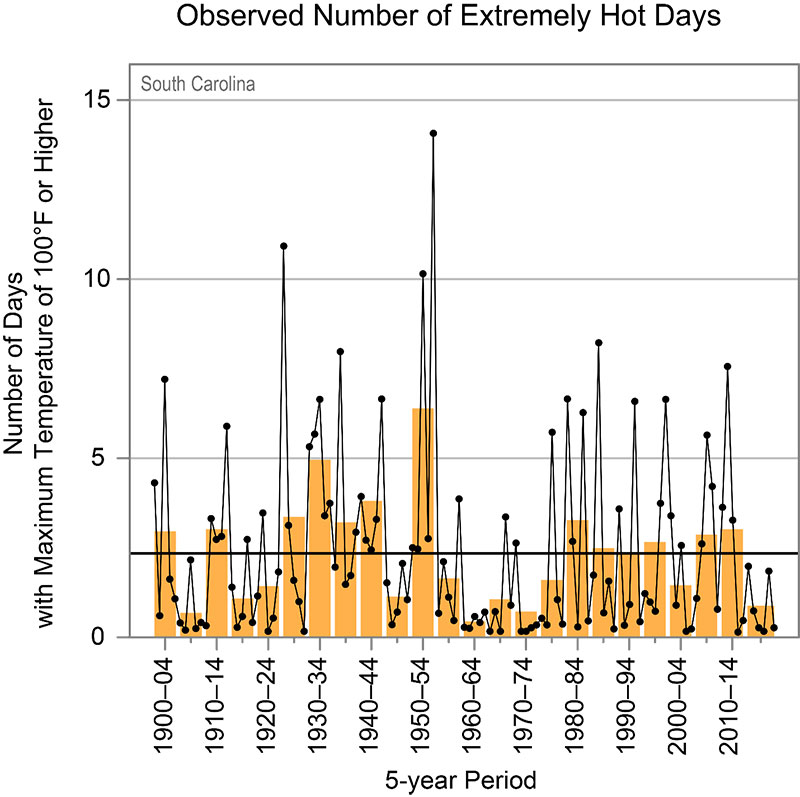
Observed number of very hot days in South Carolina since 1900. Dots are annual values. Orange bars show averages over a 5-year period, the last bar is a 6-year average. The horizontal black line shows the average of the entire period. Chart from Frankson, R., K.E. Kunkel, S.M. Champion, and D.R. Easterling, 2022: Ohio State Climate Summary 2022. - Hurricanes aren’t trending up. NOAA’s HURDAT2 database, going back to 1850, shows no increasing trend in hurricanes making landfall in South Carolina, and no increase in major hurricanes.
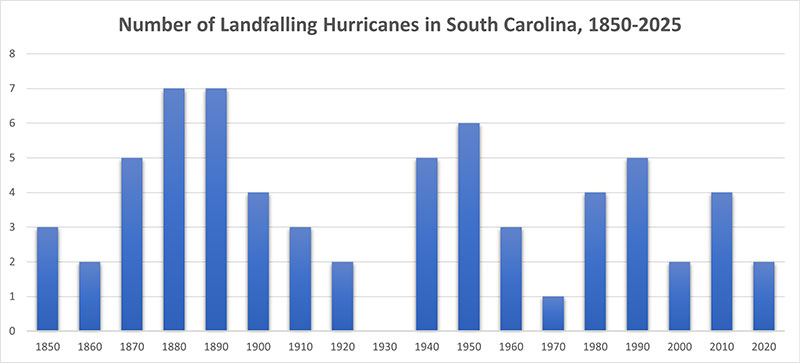
Count of landfalling hurricanes in South Carolina from 1850-2025. Data from NOAA Historical Hurricane Tracks HURDAT 2 database at https://www.climate.gov/maps-data/dataset/historical-hurricane-tracks-gis-map-viewer. - Rain and drought are flat. There is no long-term trend in either heavy rainfall or drought statewide.
- Charleston’s flooding story has a twist. Sea-level rise along the South Carolina coast has been driven largely by land subsidence rather than by climate-driven ocean warming, meaning it can be addressed through civil engineering rather than emissions policy.
- Agriculture production is way up. Peach production is up 580 percent since 2007 and cotton yields in South Carolina have gone up 448 percent since 1900.
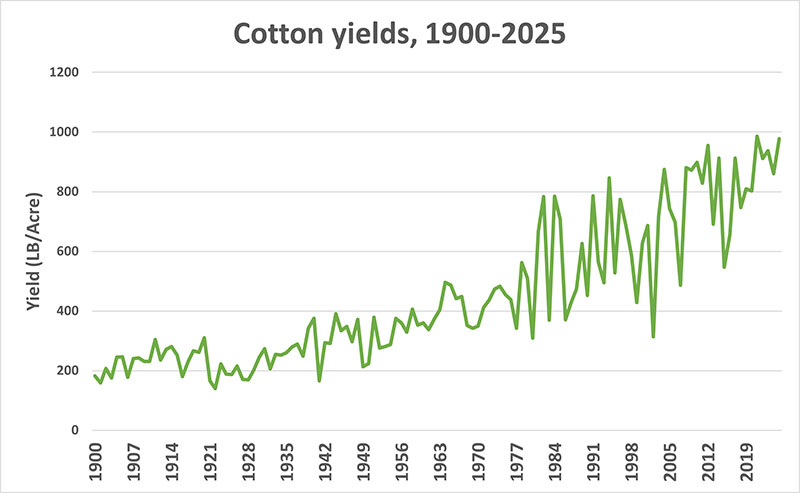
Cotton yields in South Carolina since 1900, measured in pounds per acre. Data from USDA QuickStats.
“Despite this hot summer in South Carolina, there actually is no trend in worsening heatwaves, and the rain hasn't declined over time either, which is good news for cotton and peaches. One of the few scary weather events we get here in the Lowcountry, hurricanes, are likewise not getting more frequent, nor severe, which I'm sure long-time residents can attest to if they remember the 50s and 90s!”