








Essential Economic, Energy, Religious/Social, and Military Notes
Part 1—Iran, Iraq, Kuwait, Saudi Arabia, and Qatar
The Persian Gulf nations are by region:
The Eastern shore: Iran, which occupies the entire eastern coast of 713 miles. The narrow 24-mile Hormuz Strait lies near the southern end of Iran and connects into the Gulf of Oman, leading into the Indian Ocean.
Western shore: Six Sunni Arab nations: Iraq, Kuwait, Saudi Arabia, Bahrain, Qatar, and the United Arab Emirates, and an exclave of Oman, also a Sunni Arab nation. Bahrain is an island.
The Red Sea nations are by region:
Northern shore: Israel and a narrow strip of Jordan around the Port of Aqaba.
Eastern shore: Saudi Arabia and Yemen.
Western shore: Egypt, including the Suez Canal, Sudan, Eritrea, and Dijbouti.
Iran
The Islamic Republic of Iran is a nation of 93 million people, the 17th largest in the world. It is also the 17th largest in geographic area. Iran is 99.4 % Muslim. Approximately 95% are Shia Muslims. Sixty-one percent of Iranians are ethnic Persians. The two largest minorities are the Azeri (Azerbaijani) 16% and Kurds 10%. The official language of Iran is Persian (or Farsi), which is in the larger Indo-European family of languages. Its 2026 estimated GDP-PPP (price adjusted) is $1.783 trillion, 26th highest in the world. The annual GDP-PPP per capita is $20,219, the 98th highest of about 140 nations surveyed.
Iran has the third highest proven oil reserves in the world—209,000 million barrels. Venezuela is first with 304,000 million barrels, and Saudi Arabia is second with 267,000 million barrels. Iran is seventh in crude oil extraction per day at 4.2 million barrels per day, following the United States, 86.3; Russia, 10.1; Saudi Arabia, 9.9; Canada, 5.4, Iraq, 4.4; and China, 4.3 mbd. However, Iran has a one of the lowest costs of extraction at $12.60 per barrel. The United States averages about $36.20 per barrel, and U.S shale oil is higher still at about $55 per barrel. Average Russian extraction costs per day were about $17.20 in 2015 and are probably around $20 at present. Iran, Kuwait, Saudia Arabia, Iraq, Qatar, and the UAE, all in the Persian Gulf, have the lowest production costs ranging from $8.50 to $13 per barrel.
Although Iran is an energy powerhouse with 10% of known oil reserves and 15% of known natural gas reserves (2nd in the world), the oil and gas industry is only about 23% of its GDP. Iran has a thriving industrial and scientific economy, particularly advanced in aerospace and communications technologies. Its agricultural and fishery industries give it a strong 96% food security rating by the United Nations.
This article will not deal in military detail of the Persian Gulf and Red Sea nations, but Iran is ranked 16th of 145 global military powers in the 2026 Global Firepower Review, and fourth in missile launchers. The top four are the United States, Russia, China, and India. Russia and China have become close allies of Iran.
Iran Government—The Supreme National Security Committee and the Islamic Supreme Leader
Iran has a constitutional government with an elected president, cabinet, national officers, a parliament, and judiciary, but it is overseen by an Islamic Supreme Leader, elected by religious experts. However, the real power is in the 12-13 member Supreme National Security Committee. The Chairman of this committee is the President of Iran, in this case, Masoud Pezeshkian. The other Constitutional members are the Speaker of Parliament, Chief Justice (S), Secretary (S), Representative of the Supreme Leader (S), Chief of the Army (S), Chief of the IRGC (S), Minister of Foreign Affairs (Abbas Araghchi), Minister of the Interior, Minister of the Interior, and the Chief of Planning and Budget. The Islamic Supreme Leader has both influence within the Committee—he appoints 6 of them, designated with parenthetic (S) above—and a veto over any proposals or actions of the Committee. The present Supreme Leader, Ayatollah (religious title) Mojtaba Khamenei has an IRGC background and is a veteran of the Iran-Iraq War (1980-1988).
Iraq
The population of Iran is over 46 million, It is 96% Muslim with a strong Shia Muslim majority of 61%, most concentrated near the Iranian border. There are two official languages, the dominant Arabic language and the minority Kurdish language. Between 75% to 80% of the population are Arabs. The Kurdish minority is 10-15%. The balance are predominantly other Middle Easter minorities including Assyrians and about 1.3% Yazidis. The capital is Baghdad on the Tigris River with 7.8 million people. The 2026 GDP-PPP for Iraq is $670 billion, 48th in the world. Per capita annual GDP-PPP is 110th in the world at $14,376. Iraq has the fifth largest known oil reserves in the world and is also fifth in annual extraction (production). It has one of the lowest production costs at $10.57 per barrel. The oil sector dominates the Iraqi economy. Iraq is ranked 44th in military firepower. Following the Iranian Revolution of 1979 and backed by the United States, Iraq attacked and fought a war against Iran from 1980 to 1988. Casualties were high and Iraq used chemical weapons against Iranian forces and civilians and also bombed civilians in Iranian cities. According to Britannica, Iran was able to push Iraqi forces out of its territory, and the war ended in a stalemate. Combined Iraqi and Iranian military and civilian deaths reached over 500,000.
The U.S. fought a war against Iraq (the Second Gulf War) from 2003 to 2011, which was connected to Islamic terrorism and the removal of the government of Saddam Hussein. Iraq is now a Federal parliamentary republic.
Kuwait
Kuwait is a nation of 5.0 million people situated at the northwestern edge of the Persian Gulf, near but not bordering Iran. It has 311 miles of coastline and is bordered by Iraq and Saudi Arabia. It is about 58% Arab and 75% Muslim. The official language is Arabic. Just over 40% of the population are West Asian immigrants or guest-workers. Eighteen percent of Kuwait’s population is Christian. Most of the people live in the capital of Kuwait City on the Persian Gulf with 3.4 million people. With only about 6,900 square miles of territory, it is a little smaller than the state of New Jersey. Yet it has the seventh largest known oil reserves in the world and is tenth in extraction. It presently has the lowest cost in oil production at $8.50 per barrel. It is relatively well armed, ranking 76th in global firepower. Like most of the Gulf states, it is a monarchy ruled by an Emirate. In summer, Kuwait City is one of the hottest cities on earth with daily highs reaching an average high of 113 degrees F for three months. There are several important American military bases in Kuwait.
In 1990-1991, U.S. Operation Desert Storm (First Gulf War), defended Kuwait against an Iraqi attempted invasion, In 2003-2011 (Second Gulf War), Kuwait was the springboard for the U.S. Coalition invasion of Iraq to remove the Government of Saddam Hussein. Recently, Iranian missiles and drones exacted considerable damage on the Al-Udairi American airbase in northern Kuwait.
The Kingdom of Saudi Arabia
The population of Saudi Arabia in 2024 was 33.7 million, but close to 42% of them are immigrant guest-workers, of which the vast majority are from West and especially South Asia. The official religion of Saudi Arabia is Sunni Islam, and by law all Saudi citizens must be Muslims. The official language is Arabic. Among Saudi citizens about 90% are Arabs and 10% are Afro-Arabs. However, including the temporary immigrant population, there are 2.1 million Christians (6%) and 700,000 Hindus (2%), leaving the overall Muslim total at 91%. Of these about 90% are Sunni and 10% are Shia Muslims. The Shia Muslims are concentrated on the Persian Gulf. Hardline Wahhabi Sunni Muslim Islam dominates in Saudi Arabi and discrimination and persecution against others is common. Christians and Hindus must not allow their faith to be visible or heard in the general population. Al-Qaeda terrorism has much of its origin in strict Wahhabi doctrines based on the Quran and especially the words and traditions of Muhammad.
Saudi Arabia has the second highest known petroleum reserves exceeded only by Venezuela. Iran is third. Saudi Arabia is third in production and has one of the lowest production costs at $8.98 per barrel.
Saudi Arabia has the 12th largest territory in the world and borders both the Persian Gulf to the east and the Red Sea to the west. It is bordered by Jordan, Iraq, and Kuwait on the north, Bahrein, Qatar, and the United Arab Emirates (UAE) on the east. It borders Oman to the southeast and Yemen to the south. The Gulf of Aqaba links it to Egypt and Israel.
The estimated GDP-PPP for Saudi Arabia in 2026 is $2,9 trillion, 17th in the world. Annual per capita GDP-PPP is $78,815, 19th in the world. Saudi Arabia also has the sixth largest proven natural gas reserves. Sixty-three percent of Saudi Arabia’s economy is based on petroleum.
The government of Saudi Arabia is an absolute monarchy ruled by King Salman bin Abdulaziz Al-Saud and his son, Crown Prince Mohammad bin Salman (MBS) Al-Saud, who is Prime Minister. The Basic Law of Saudi Arabia is Sharia (Islamic Law) based on the Quran and Sunnah (Traditions of Mohammad). Global Firepower ranks Saudi Arabia as having the 25th most powerful Armed Forces in the world. This is second only to Turkey in the Middle East, which ranks ninth in the world. Turkey is also the second most powerful military force in Europe, save the United States. An Iranian attack on and east-west pipeline pumping station in April has temporarily reduced Saudi export by 700,000 barrels a day. Another military vulnerability for Saudi Arabia is that it is 50-70% reliant on desalinization plants for drinkable water.
The largest city and capital of Saudi Arabia is Riyadh with 7.0 million people. Four other cities have populations over one Million: Jeddah, Dammam, Mecca, and Medina. The last two cities were residences of the Prophet Mohammad, ca. 570-632 AD. The average daily high temperature in Jeddah rises to 108-110 degrees F from June through August.
Qatar
Qatar is a small peninsula jutting north into the Persian Gulf from the eastern coast of the world’s largest peninsula, the Arabian Peninsula. It is actually called the State of Qatar and is officially a unitary authoritarian semi-constitutional monarchy ruled by Emir Tamis bin Hamad. Its legislature is a Consultative Assembly of 45 members appointed by the Emir. Less than 4,500 square miles in territory, it is about 100 miles long north to south and 50 miles wide, slightly smaller than than Connecticut and Rhode Island combined.
The population of Qatar is estimated to be 3.2 million, but only 12.5% of these, 400,000, are Qatari natives and citizens. The rest are guest-workers whose numbers fluctuate according to the season and economy. About 49% of the population are Qatari or other Arabs. A whopping 43% are South Asians from the Indian subcontinent. More than half—22% are Indian immigrants. Another 7% come from around the world. Islam is the official religion, and about 66% are Muslins. Hindus are 15%, Christians 14%, and Buddhists 3%.
Qatar was part of the Ottoman Empire but became a British protectorate after World War I. Qatar’s independence was granted in 1971.
The GDP-PPP for Qatar was $378 billion in 2025. The per capita GDP-PPP was $71,650, ranking ninth in the world. Qatar has the 14th largest proven oil reserves in the world. Its petroleum production ranks 16th in the world at over 1.3 million barrels per day. Its extraction costs are estimated at $10-15 per barrel.
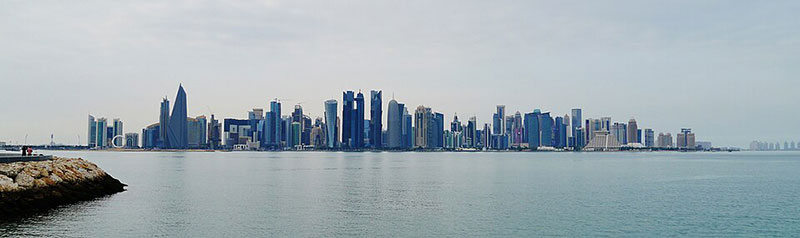
Doha is Qatar’s gleaming glass and steel capital located on its eastern coast. It population is 1.2 million, but its metro population is 2.0 million.
Qatar is an important military ally of the United States. More than 10,000 U.S. Armed Forces personnel are stationed at Al-Udeid Air Base, the largest American military base in the Middle East. For a small country, Qatar has a relatively impressive air force. Global Firepower Review ranks Qatar 71st of 145 nations.
Ironically, the Qatar monarchy has been a major financial supporter of the Muslim Brotherhood and has strong relations with Turkey, which also has a military base in Qatar. There may be as many as 2,000 Turkish troops at the Tariq bin Ziyad Barracks.
Next Week Part 2
Part 2 will begin with the United Arab Emirates (UAE) and Oman on the Persian Gulf and then begin our review of the Red Sea nations. Approximately 12% of global oil shipments come through the Red Sea, which has a narrow 16-mile southern choke-point vulnerable to attack by Yemeni Houthi forces allied with Iran.
 Mike Scruggs is the author of two books: The Un-Civil War: Shattering the Historical Myths; and Lessons from the Vietnam War: Truths the Media Never Told You, and over 600 articles on military history, national security, intelligent design, genealogical genetics, immigration, current political affairs, Islam, and the Middle East.