








Disturbing Trends and Implications
The Strategic Petroleum Reserve (SPR) is the United States’ largest emergency crude oil stockpile, authorized in 1975 to protect against major supply disruptions following the 1973–74 oil embargo by the Organization of Arab Petroleum Exporting Countries (OAPEC) in October 1973 against nations supporting Israel in the Yom Kippur War.
Yom Kippur is the Jewish religious holiday—"Day of Atonement”—emphasizing repentance for sins and seeking God’s forgiveness. The date of Yom Kippur varies beginning on a Sunday evening for 25 hours into Monday. The Yom Kippur War was a surprise attack on Israel primarily by Egypt and Syria and lasted only from October 6-25, 1973. The purpose of the attack was to recover territories lost by Egypt and Syria in the 1967 Six-Day War. The Yom Kippur War was the fourth Arab war against Israel since its 1948 founding. The first was the 1948 Arab-Israeli War and the second was, the 1956 Suez Crisis War. There have been numerous periods of Arab-Israeli conflicts since then. The Hamas attack on Israel from Gaza on October 7, 2023, began the current conflict and escalated into the War with Iran in June 2025, resuming in late February 2026. Actually, Israel has been in conflict with Iran since 1985.
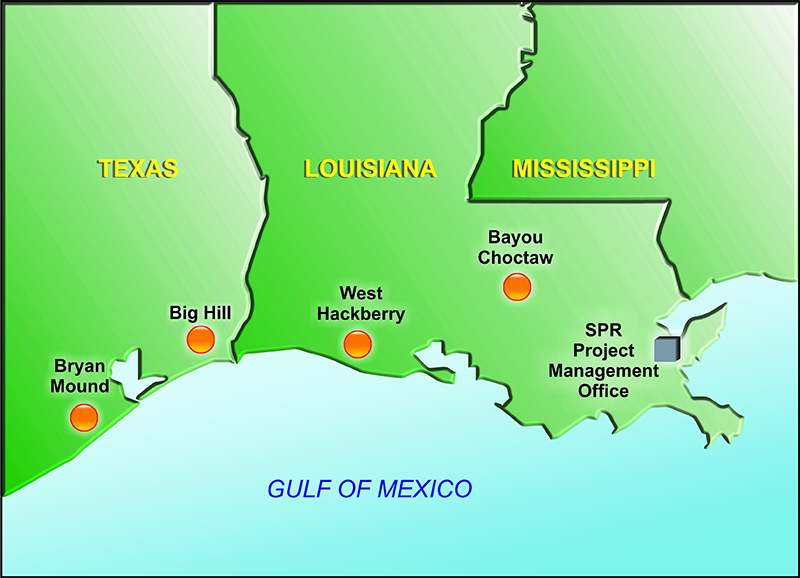
There are presently four storage locations in Texas and Louisiana with a maximum capacity of 714 million barrels. “Sweet” crude oil with a maximum 0.5% sulfur by weight and “sour” crude oil with up to 1.99% sulfur must be stored separately. Sour crude oil is thicker and more difficult to refine. The original objective was to keep at least 90 days equivalent of imported crude oil in reserve for national emergencies. Note that these emergency reserves are crude oil and not refined petroleum products like gasoline, diesel, and airline fuels. Current U.S. lack of refining capacity could limit rapid conversion of oil reserves to ready fuels.
The four locations are all along the Gulf coast and near refineries and population centers. The crude oil in these Department of Energy facilities is stored in 60 underground artificial salt caverns carved out of deep salt domes. The salt caverns are on average about 2,000 feet deep with some as much as 3.300 feet deep. The caverns are on average about 200 feet wide. Capacities range from 6 to 37 million barrels. The cost of construction was $4.0 billion.
Bryan Mound, Freeport Texas, with a total capacity of 254 million barrels stored in 20 artificial salt caverns.
Big Hill, Winnie, Texas (26 miles Beaumont) with 160 million barrels capacity.
West Hackberry, Lake Charles Louisiana, with 227 million barrels capacity.
Bayou Choctaw, Baton Rouge, Louisiana, with 76 million barrels capacity.
The total drawdown capacity per day is 4.4 million barrels. At this rate, a 90-day reserve would require 396 million barrels in inventory. Maximum capacity could be drawn out in 162 days. Average usage of refined petroleum products in the United States is about 20.25 million barrels per day (2023), nearly 5 times what the SPR can release per day.
SPR reserves are now being depleted to keep gasoline prices down in the U.S. as oil prices have soared because of the uncertainty of obtaining oil from the Persian Gulf through the Iranian dominated Strait of Hormuth, through which passes about 20% of seaborne oil exports to global ports. This is because of the U.S. and Israeli War against Iran. While the U.S. Navy has instituted a blockade of the Persian Gulf to force Iran to give up control of Hormuth, the blockade itself is hindering badly needed oil around the world and is thus intensifying rather than relieving the crisis.
In addition to oil, the Hormuz crisis is blocking 25% of natural gas, 35% of Fertilizer, and more than 30% of global helium production in Qatar. Helium is critically important to manufacturing semiconductors, which are even more in demand now with rapid AI expansion.
Present U.S. SPR Inventory
As of May 29, 2026, SPR total crude oil inventory was 357.1 million barrels—137 million barrels of SWEET and 220.1 million barrels of SOUR. This is right at 50% of capacity, 81 days of pumping capacity. Moreover, since the February 28 beginning of the Iran War, we have depleted inventory by 58.1 million barrels. We are depleting emergency reserves by approximately 20 million barrels a month to hold down consumer gasoline prices. Meanwhile the price of replenishing our SPR is going up. Here is a way to check for yourself every week: Strategic Petroleum Reserve Inventory 2005 (gives the latest 2026 figure now).
The maximum historical withdrawal from the SPR was during the Biden Administration at the beginning of U.S. involvement in the Ukraine proxy War against the Russian Federation in 2022 with the objective of holding consumer gasoline prices down. There were also significant drawdowns during the 1991 Gulf War and during Hurricane Katrina in 2005.
International SPR Inventories
There are 32 members of the International Energy Agency, which have SPRs. Typically these try to accumulate and store the equivalent requirement of 90 days of imported oil. The International Energy Agency also has its own SPR of 1.2 billion barrels. They recently agreed to release 400 million barrels to soften member state stresses caused by the Iranian War and Strait of Hormuz crisis.
China now has the largest SPR inventory at 1.4 billion barrels. In 2025, 80% of China’s oil imports came from Iran.
Japan, which has few domestic petroleum resources, has an SPR inventory of 470 million barrels. Spain’s SPR inventory is 150 million and Germany’s is 110 million barrels. France has 97 million barrels, and Italy 96 million barrels. The UK has only 38 million SPR barrels but also has a refined energy inventory of 30 million barrels.
On February 28, the start of renewed Israeli and American war on Iran, West Texas Intermediate (Sweet or Light) oil per barrel (WTI) closed at $69.76 per barrel. It closed at $90.54 on June 6. It has been fluctuating wildly with news on the Iran War and President Trump comments on social media, having reached as high as $117 in the last few weeks. Reports from the field indicate that market oil prices are much higher than WTI quotes. WTI daily quotes are not market spot prices. They are calculated Futures prices for the next month. Hence the June 6 WTI price may not reflect spot price realities. Many prefer Brent Crude as a better index of oil prices. Brent Crude closed at $93.86 per barrel on June 6. Both WTI and Brent prices are easily found on the internet. I recommend investors and those who want to judge and forecast the broader economic future to access WTI through Yahoo Finance, for which the basic app is free.
On June 5, the NASDAQ stock index dropped 1,121.53, 4.18%, a loss of $1.7 trillion in market capital, the biggest loss in the history of NASDAQ’s 55 years, going back to February 1971. I think this represented more than just a correction or rotation out of AI stocks, which have made an extraordinarily profitable run. I believe that profitability run has a lot longer and further to go. However, Wall Street has been slow to catch on that the Iran War could wipe out a third of oil, gas, fertilizer, and helium production that comes out of the Persian Gulf for 5-10 years. Helium, by the way, is extremely important to semiconductor production. Moreover, another 12% of seaborne petroleum products now pass through the Red Sea southern choke point of the Bab-el-Mandeb Strait. The Iranian allied Yemeni Houthi, now the dominant military and political force in most of Yemen, have proved they have effective missile coverage of Bab-el-Mandeb. These losses of resources and production over a long recovery period risk a major economic depression.
 Mike Scruggs is the author of two books: The Un-Civil War: Shattering the Historical Myths; and Lessons from the Vietnam War: Truths the Media Never Told You, and over 600 articles on military history, national security, intelligent design, genealogical genetics, immigration, current political affairs, Islam, and the Middle East.