












- “Farms That Grow Nothing” Served at the Republican Runoff Breakfast Table
- Pakistan, the Iran War, and Regional Security
- The Iran War, the 14-Point Memorandum, and AIPAC
- When the Liberty Bell Found Its True Voice
- Back to Basics: Understanding Your Greenville County Property Tax Bill from Start to Finish
- The 14-Point Memorandum of Understanding
- The Republic of Türkiye and the Iran War
- Advocates for Faith & Freedom Files Election Integrity Lawsuit Seeking Answers from California Secretary of State
- American Independence and the Battle of Cowpens
- Turkish Naval Force Deploys in Eastern Mediterranean
- The Ukrainian Drone Attacks on Wildberries
- The $8 Billion that SC Lawmakers Don't Talk About
- Eagle Forum Applauds FTC Lawsuit Against WPATH
- Pro Baseball Team Forfeits after Players Reject Pride Uniforms
- Update on the Trump Administration’s Robust and Rapid Delivery of Life-Saving U.S. Assistance to Venezuela
Pat Buchanan
Is Putin Considering Using Nukes on NATO?
- Details
- By Pat Buchanan
From his principal avenues of attack on Ukraine, Russian President Vladimir Putin began this war with three strategic goals.
Send an army south from Belarus to capture Ukraine's capital, Kyiv, and replace the government. Send forces into northeast Ukraine to capture its second largest city, Kharkiv, with 1.4 million people.
Third, extend the Donetsk enclave westward to establish a land bridge to Crimea and give Russia full control of the Sea of Azov and most of the Ukrainian coast along the Black Sea.
This last objective is almost achieved. Yet, as of Monday evening, five days into the war, neither Kyiv nor Kharkiv had fallen, though Russia had committed most of the troops it had assembled for the invasion.
Did We Provoke Putin's War in Ukraine?
- Details
- By Pat Buchanan
When Russia's Vladimir Putin demanded that the U.S. rule out Ukraine as a future member of the NATO alliance, the U.S. archly replied: NATO has an open-door policy. Any nation, including Ukraine, may apply for membership and be admitted. We're not changing that.
In the Bucharest declaration of 2008, NATO had put Ukraine and Georgia, ever farther east in the Caucasus, on a path to membership in NATO and coverage under Article 5 of the treaty, which declares that an attack on any one member is an attack on all.
Unable to get a satisfactory answer to his demand, Putin invaded and settled the issue. Neither Ukraine nor Georgia will become members of NATO. To prevent that, Russia will go to war, as Russia did last night.
Are Democrats Kicking Away Their Future?
- Details
- By Pat Buchanan
Not so long ago, Democrats seemed the party of the future.
"Inevitable!" predicted some pundits, for demography is destiny.
Moreover, in 2020, Democrats, who had won the popular vote six times in seven presidential elections, swept the popular vote again, by 6 million ballots. And they captured both houses of Congress.
The future did seem to be theirs.
Has Putin Won Round One in Ukraine?
- Details
- By Pat Buchanan
When NBC's Lester Holt asked President Joe Biden what might prompt him to send U.S. troops to rescue Americans fleeing Ukraine, Biden replied: "There's not. That's a world war when Americans and Russia start shooting at one another."
"It's not like we're dealing with a terrorist organization. We're dealing with one of the largest armies in the world. ... Things could go crazy quickly."
Biden was saying Americans are not going to fight Russians in Ukraine, even to protect or extract imperiled U.S. troops, diplomats or citizens.
Speaking last week on the Senate floor, Sen. Ted Cruz echoed Biden: "I want to be clear and unequivocal. ... Under no circumstances should we send our sons and daughters to die to defend Ukraine from Russia."
The Richard Nixon His Loyalists Knew
- Details
- By Pat Buchanan
Whenever America is polarized, as it is today, people go back in memory and history to recall other times their nation was so divided.
The Civil War of the 1860s and the social revolution that tore us apart in the 1960s come instantly to mind. In that latter time, there was no figure more central to the conflicts of his day than Richard M. Nixon.
And no staff member was closer to Nixon in the campaign of 1968, or for the first four years of his presidency, than his personal aide Dwight Chapin, whose memoir, "The President's Man," is published this week.
Coincidentally, this February of 2022 is the 50th anniversary of Nixon's trip to China that changed the world. Chapin was at Nixon's side every day of that trip and had negotiated with the Chinese to prepare the schedule for both the president and first lady Pat Nixon.
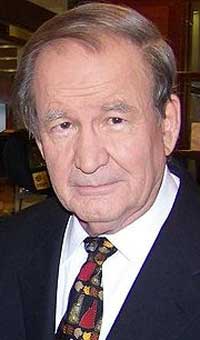 Patrick J. Buchanan is the author of a new book, "Nixon's White House Wars: The Battles That Made and Broke a President and Divided America Forever." To find out more about Patrick Buchanan and read features by other Creators writers and cartoonists, visit the Creators website at www.creators.com.
COPYRIGHT 2018 CREATORS.COM
Browse by the Top Tags ...