










- “Farms That Grow Nothing” Served at the Republican Runoff Breakfast Table
- Pakistan, the Iran War, and Regional Security
- The Iran War, the 14-Point Memorandum, and AIPAC
- When the Liberty Bell Found Its True Voice
- Back to Basics: Understanding Your Greenville County Property Tax Bill from Start to Finish
- The 14-Point Memorandum of Understanding
- The Republic of Türkiye and the Iran War
- Advocates for Faith & Freedom Files Election Integrity Lawsuit Seeking Answers from California Secretary of State
- American Independence and the Battle of Cowpens
- Turkish Naval Force Deploys in Eastern Mediterranean
- The Ukrainian Drone Attacks on Wildberries
- The $8 Billion that SC Lawmakers Don't Talk About
- Eagle Forum Applauds FTC Lawsuit Against WPATH
- Pro Baseball Team Forfeits after Players Reject Pride Uniforms
- Update on the Trump Administration’s Robust and Rapid Delivery of Life-Saving U.S. Assistance to Venezuela
Pat Buchanan
Stress Test for a Fading Superpower
- Details
- By Pat Buchanan
Because America entered both world wars of the 20th century last, while all the other great powers bled one another, and because we outlasted the Soviet Empire in the Cold War, America emerged, in the term of President George H.W. Bush, as "the last superpower."
We had it all. We were the "indispensable nation." We saw further into the future. We could impose our "benevolent global hegemony" on all mankind. And so it was that we set out to create a "new world order," plunging into successive wars in Iraq, the Balkans, Afghanistan, Iraq again, Syria, Libya, Yemen.
So doing, we bled ourselves, distracted ourselves, exhausted ourselves and sundered ourselves, until half the country was echoing George McGovern's 1972 campaign slogan: "Come home, America."
Putin Wants His Own Monroe Doctrine
- Details
- By Pat Buchanan
When the Union was fighting to preserve itself in the Civil War, the France of Napoleon III moved troops into Mexico, overthrew the regime of Benito Juarez, set up a monarchy and put Austrian Archduke Maximilian von Habsburg on the throne as Emperor of Mexico -- one month before Gettysburg.
Preoccupied, the Union did nothing.
At war's end, in 1865, however, at the urging of Gens. Ulysses S. Grant and William Sherman, the Union sent 40,000 troops to the Mexican border.
Secretary of State William Seward dispatched Gen. John Schofield to Paris with the following instructions: "I want you to get your legs under Napoleon's mahogany and tell him he must get out of Mexico."
What Matters Most to Nations and Peoples?
- Details
- By Pat Buchanan
Speaking in Conroe, Texas, last weekend, former President Donald Trump accused his successor of allowing millions of migrants to enter the country illegally across our Southern border.
"The most important border ... for us is not Ukraine's border but America's border," thundered Trump.
"Before Joe Biden sends any troops to defend a border in Europe, he should be sending troops to defend our border right here in Texas."
Thus did Trump not only frame a compelling issue for the fall election; he has framed an issue that touches on one of the great and deepening divides of our time.
NATO -- Strategic Asset or Liability?
- Details
- By Pat Buchanan
Is the territorial integrity of Ukraine a cause worth America's fighting a war with Russia?
No, it is not. And this is why President Joe Biden has declared that the U.S. will not become militarily involved should Russia invade Ukraine.
Biden is saying that, no matter our sentiments, our vital interests dictate staying out of a Russia-Ukraine war.
But why then does Secretary of State Antony Blinken continue to insist there is an "open door" for Ukraine to NATO membership -- when that would require us to do what U.S. vital interests dictate we not do: fight a war with Russia for Ukraine?
NATO's "open door policy" is based on Article 10, which declares that NATO members, "may, by unanimous agreement, invite any other European State ... to accede to this Treaty."
Is Democracy Dying or America Disintegrating?
- Details
- By Pat Buchanan
"What do we mean by the Revolution? The war? That was no part of the revolution; it was only an effect and consequence of it. The revolution was in the minds of the people."
What did John Adams mean when he wrote this to Thomas Jefferson in 1815, after both had served as president?
Adams was saying that America, the country that took up arms and fought for its independence from the British, was already a nation -- before 1775.
America preexisted the Constitution, Adams is saying. America had been conceived and born before he and Jefferson began to write its Declaration of Independence in Philadelphia in 1776. America had come into being even before Lexington and Concord in 1775.
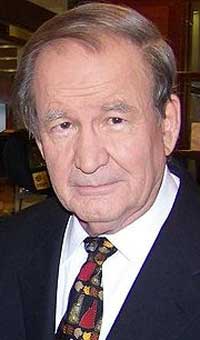 Patrick J. Buchanan is the author of a new book, "Nixon's White House Wars: The Battles That Made and Broke a President and Divided America Forever." To find out more about Patrick Buchanan and read features by other Creators writers and cartoonists, visit the Creators website at www.creators.com.
COPYRIGHT 2018 CREATORS.COM
Browse by the Top Tags ...